Open Air Dispatch - Page 2 of 11 - Bestop | Leading Supplier of Jeep Tops & Accessories

eTop vs Sky One-Touch: Which Power Top Is Right for Your Jeep?

Key Takeaways

    • The Jeep Sky One-Touch Power Top is a factory-ordered hybrid roof with a retractable powered center panel, while the Bestop eTop is the world’s only aftermarket powered full soft top.
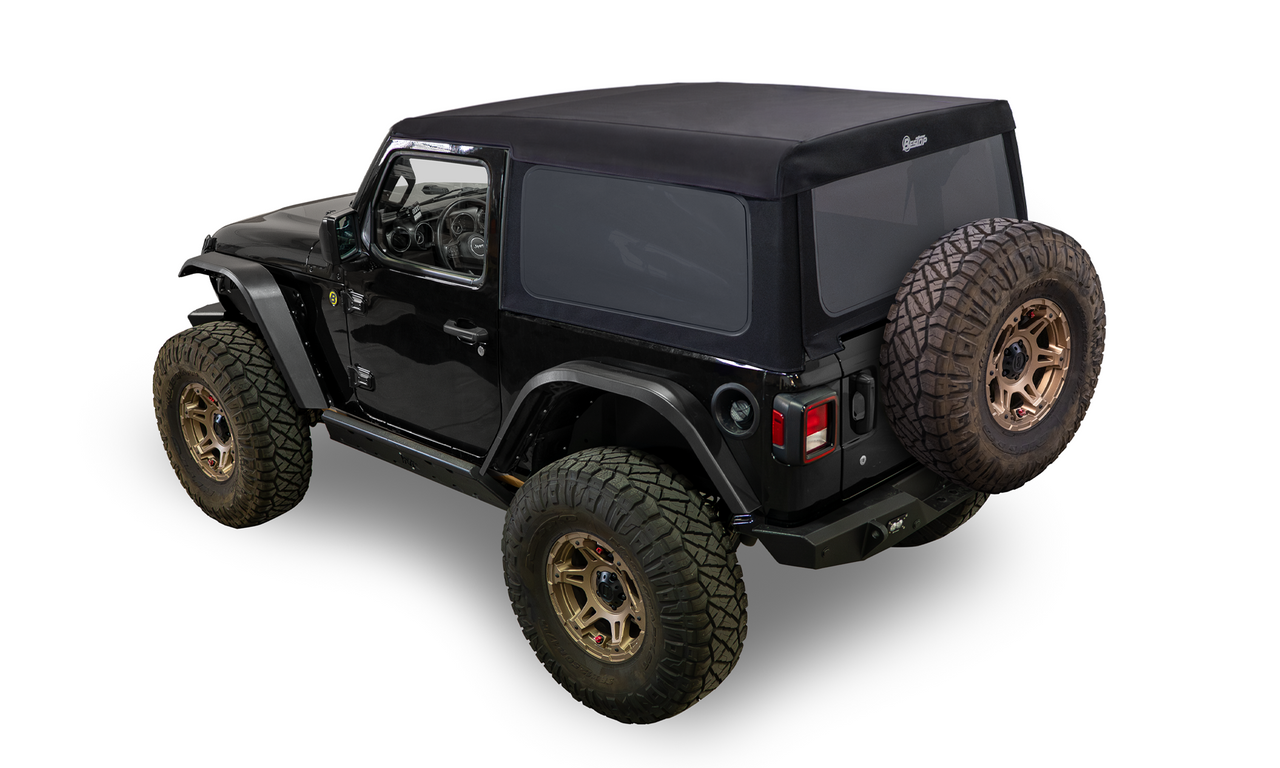
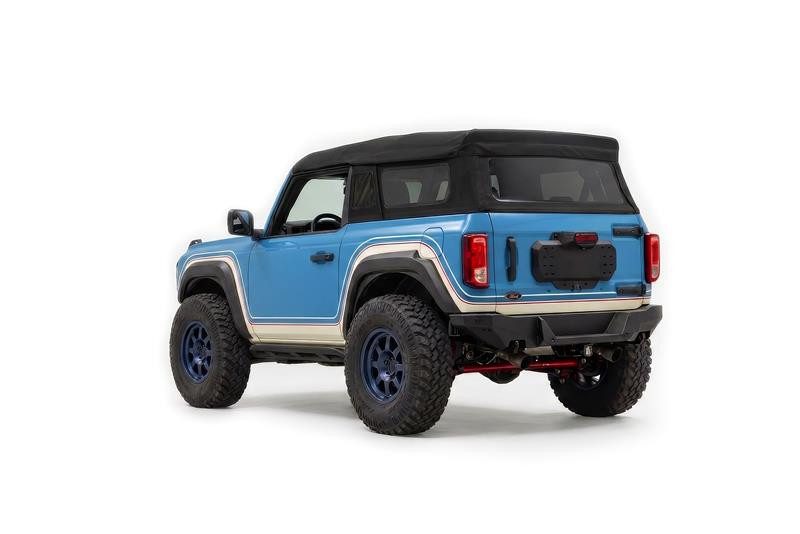
    • The eTop is engineered for the Jeep Wrangler JL & 2 Door and the Ford Bronco in both 2-door and 4-door configurations, and the Jeep Wrangler JK (4-door).
    • The eTop is priced at $5,295 for the Black option and $5,695 for color options, before installation. The Sky One-Touch is a factory add-on directly from Jeep and generally costs between $2,000 and $3,995 MSRP, depending on the specific Wrangler model and trim level.

Open-air freedom should feel effortless. You press a button, and the sky opens. Two power tops promise exactly that for your Jeep Wrangler: the factory Jeep Sky One-Touch Power Top and the aftermarket eTop from Bestop. Both open the roof at the touch of a button, but they take different paths to get there. This eTop vs Sky One-Touch guide explains how each one does this, how they compare, and which power top fits your Jeep, your budget, and the way you actually want to drive it. As Jeep’s sole OEM soft top supplier since 1986, Bestop knows open-air Jeeps, and we will keep this comparison honest. Want the full picture first? Explore the Bestop eTop.

eTop vs Sky One-Touch at a Glance

The core difference is simple. The Jeep Sky One-Touch is a factory-installed hybrid roof—a rigid top with a powered fabric panel that retracts over fixed rails. It can only be selected when ordering a new Jeep and cannot be added after purchase. The Bestop eTop is a fully retractable, open-air, powered, aftermarket soft top. It is a full soft top that opens completely at one touch, and it can be added to applicable Jeeps and Broncos at any time. Put simply, the Sky One-Touch is a factory hybrid hard top/soft top that opens along the roof onlyThe eTop is a true, fully open cabin powered soft top available aftermarket.

Feature Jeep Sky One-Touch Power Top Bestop eTop
Type Factory hybrid roof: rigid top with a powered fabric center panel Full powered soft top (world’s only aftermarket power soft top)
Operation One-touch powered center panel fabric that slides over fixed rails One-touch electric, opens in seconds with no latches or panel removal
Vehicle fit Jeep Wrangler only Jeep Wrangler JL and Ford Bronco (2-door and 4-door), Jeep Wrangler JK (4-door)
Factory vs aftermarket Factory option, ordered with a new Jeep Aftermarket upgrade, added whenever you choose
Open-air feel Center panel retracts; rear roof structure stays fixed Retracts fully for a more open feel front to back
Seasonality All-season All-season, with nine-layer premium fabric
Can you add it after purchase? No, it must be ordered with the new vehicle Yes, for eligible Jeep and Bronco models

What Is the Jeep Sky One-Touch Power Top?

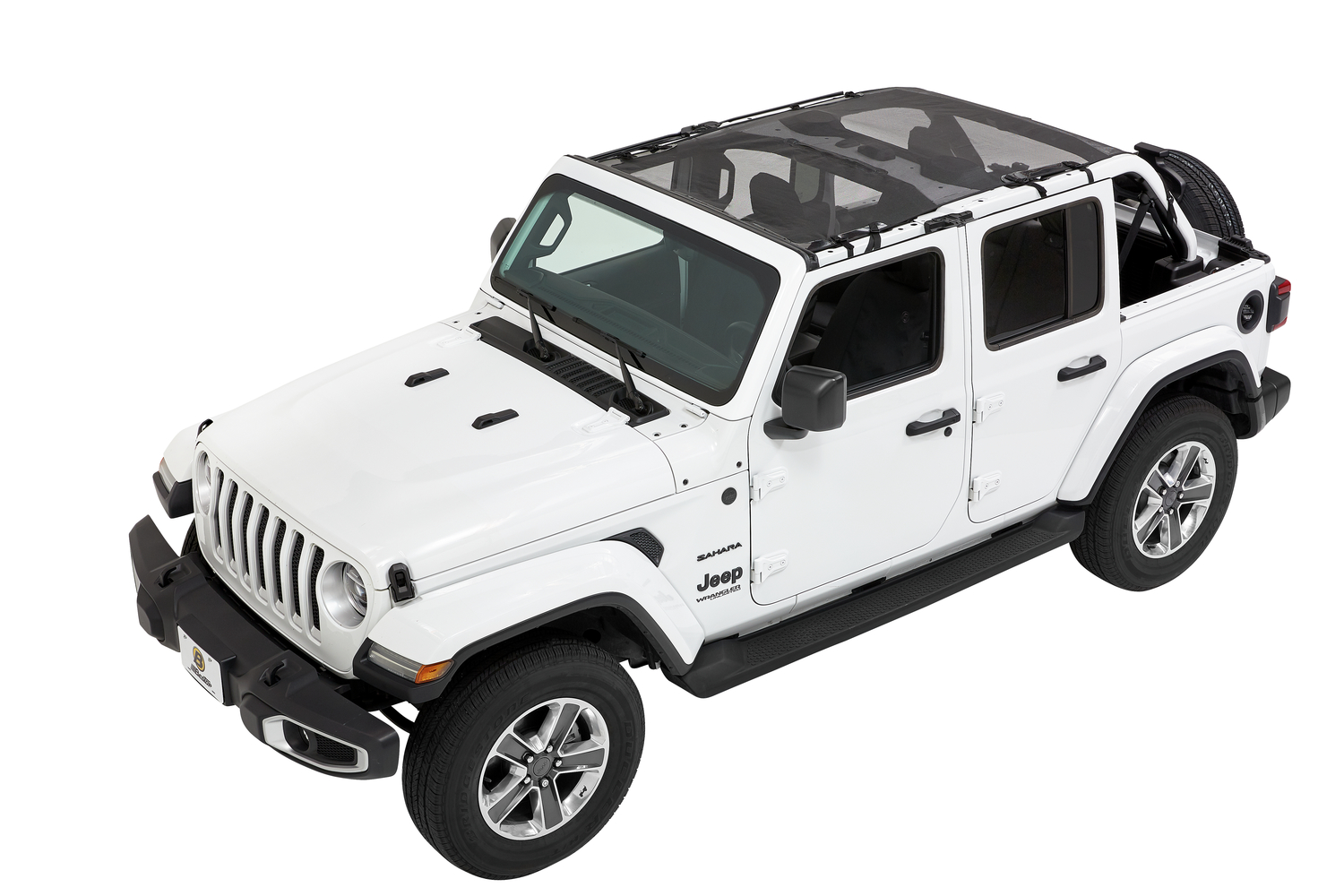
The Jeep Sky One-Touch Power Top is a factory-installed power roof that you must order with a new Jeep Wrangler. It uses a hybrid design: a rigid top with a retractable powered fabric center panel that slides open over fixed side rails. It is not a full soft top, and it is not a full hardtop. Instead, it blends elements of both into one roof, similar to a moon roof.

The Sky One-Touch is a genuinely strong factory option. Many owners like push-button sky access without giving up a solid roofline. It works well for customers who want to keep their hardtop structure.

Because the Sky One-Touch roof is integrated into the vehicle at the factory, it is only available on Jeep models and must be selected when the vehicle is ordered. It cannot be added after purchase. That timing matters: it is a decision made at the dealership, not a later addition. To see how it lines up against traditional and premium tops, our Jeep Wrangler soft top buyer’s guide breaks down every style.

What Is the eTop?

The eTop by Bestop is the world’s only aftermarket powered soft top. One button opens it in seconds: no panel removal, no storage, and no planning. It is built to OEM-grade precision, the same engineering standard behind Bestop’s factory tops, and wrapped in nine-layer premium fabric with a premium headliner that drastically cuts cabin noise. The eTop is Bestop’s Ultra-Premium flagship soft top, and it fits the JL 2 and 4 DR, JK 4 DR, Bronco 2 and 4 door. It turns open-air driving into instant open-air freedom on a whim, rather than something you plan around.

  • One-button operation: The eTop opens and closes at the push of a button, so open-air freedom takes seconds, no planning needed. 
  • No panels, no storage: There are two latches but nothing to remove, or find garage space for.
  • OEM-grade fit and sealing: Built to the same precision standard as Bestop’s OEM tops for confident, quiet driving.
  • All-season fabric: Nine-layer premium fabric and a premium headliner keep the cabin comfortable year-round.

You can find the eTop for the 2-door Wrangler JL and the 4-door Wrangler JL on Bestop’s site. The eTop is priced at $5,295 for the Black option and $5,695 for color options. The eTop is available for both Jeep and Bronco models and requires installation by an authorized eTop installer. With Bestop’s white-glove service, the eTop Customer Service team will guide you through selecting an installer in your area and support you throughout the entire installation process.

Key Differences That Matter

Factory Option vs Aftermarket Upgrade

This is the most significant difference between the Sky One-Touch and the Bestop eTop, and it’s an important consideration. The Sky One-Touch is a factory-installed option that must be added when ordering a new Wrangler, while the eTop is an aftermarket system that can be added later to compatible Jeep Wrangler JL and JK models.

For owners who didn’t select the Sky One-Touch, or bought their Jeep used, that distinction matters. The eTop makes powered open-air driving available without requiring the purchase of another vehicle, giving Jeep owners the flexibility to upgrade when they’re ready (even from a Sky One-Touch). The eTop provides an alternative path, allowing owners to decide later whether a power-operated top fits their driving style and budget.

How Open Is Open-Air?

How open is open-air when it comes to a soft top? The Sky One-Touch retracts its powered fabric center panel only, while the sides and rear roof structure stays in place, giving you an open sky view above the seats only. The eTop retracts fully, opening the cabin from the windshield back for a complete open-air feel. Both operate at one touch, so the real question is how much open view driving you want to experience. If maximum open-air freedom is the goal, the eTop delivers more of it. For most Jeep owners, that fuller opening is the moment a Jeep starts to feel like true freedom rather than a sunroof-style peek at the sky.

Everyday Comfort and Noise

Is a powered soft top quiet enough for daily driving? The eTop is built for it. Its nine-layer premium fabric and headliner drastically cut cabin noise. The eTop gives the Jeep Wrangler the convenience of a fully powered soft top while maintaining a comfortable driving experience for everyday use.It suits the morning commute and the golden-hour detour alike, without the cabin roar many drivers expect from a soft top.

Which Should You Choose?

Which power top is right for you? It comes down to where you are in the journey and how open you want your open-air to feel. Here is a quick way to decide.

  • Looking to upgrade your Jeep: The eTop gives you a fully powered soft top that can be added to eligible JL and JK models, making it a flexible option whether you already own your Jeep or are purchasing one.
  • Want a factory-installed option: The Sky One-Touch is available only when ordering a new Jeep Wrangler and cannot be added after purchase.
  • Want the fullest open-air feel: The eTop retracts completely, opening the whole cabin rather than a center panel.

The Bottom Line

The Bestop eTop brings push-button open-air freedom to your Jeep with a fully powered, retractable soft top that can be added to eligible vehicles after purchase. Unlike the factory-installed Sky One-Touch, the eTop gives Jeep owners the flexibility to upgrade when they’re ready. If effortless, everyday open-air freedom is what you are after, the eTop is worth a closer look. Take your time, weigh how you drive, and picture what the eTop could add to your daily routine.

Frequently Asked Questions About the eTop and Sky One-Touch

Common questions buyers ask when comparing the Bestop eTop with the Jeep Sky One-Touch Power Top.

What Is the Difference Between the eTop and the Sky One-Touch?

The Jeep Sky One-Touch is a factory power top ordered with a new Wrangler that slides its fabric center panel back over a fixed rail structure. The Bestop eTop is an aftermarket, fully powered soft top you can add later that retracts far back at the push of a button for a wide-open, convertible-style experience.

Can You Add a Power Soft Top to a Jeep Without the Sky One-Touch?

Yes. The Sky One-Touch must be ordered from the factory with a new Wrangler, so owners who skipped it, or bought used, cannot add it later. The Bestop eTop solves that: it installs on Jeep Wrangler JL and JK models as an aftermarket upgrade, giving any eligible Jeep push-button open-air freedom.

Does the eTop Fit Both Jeep Wrangler and Ford Bronco?

Yes. The Bestop eTop is engineered for the Jeep Wrangler JL and the Ford Bronco in both 2-door and 4-door configurations, plus the Jeep Wrangler JK (4-door), all built to OEM-grade precision. The Sky One-Touch, by contrast, is a Jeep-only factory option and is not available for the Bronco.

How Fast Does the eTop Open?

The eTop goes from fully closed to open air in seconds with one-touch electric control, no latches to release, no panels to remove, and nothing to store. The Sky One-Touch also opens at the push of a button, but its fixed rear structure stays in place rather than retracting fully like the eTop.

Is a Powered Soft Top Quiet Enough for Daily Driving?

Yes. The eTop uses nine-layer premium fabric and a neoprene headliner that cuts cabin noise by up to 5 dB, so it drives comfortably every day. Owners routinely describe it as at least as quiet as a hardtop, making it well suited to commuting, not just weekend trips.

Is the Sky One-Touch a Soft Top or a Hardtop?

The Sky One-Touch is a hybrid: a rigid roof structure with a retractable fabric center panel that powers back to open the cabin. It is not a full soft top and not a full hardtop. The Bestop eTop is a true powered soft top that retracts far back for a more open, convertible-like feel.

How Much Does the Bestop eTop Cost?

The eTop is priced at approximately $4,995 for both Jeep and Bronco. Because pricing and configurations change, confirm current figures on Bestop’s eTop page before you buy. The eTop anchors Bestop’s Ultra-Premium tier as its flagship powered soft top.

Ford Bronco Soft Tops: The Complete Buyer’s Guide

Key Takeaways

  • Bestop builds four Ford Bronco soft top options for the 2021 and newer Bronco: the Trektop Slantback, the Sunrider for Hardtop, the Skyrider for Hardtop, and the powered eTop.
  • Ford’s factory soft top is offered mainly on the four-door Bronco, and the accessory soft top Ford sells for the Bronco is built by Bestop to Ford OEM standards.
  • Hardtop owners can add open air without giving up the hardtop, since the Sunrider and Skyrider replace overhead panels while keeping the rest of the roof in place.
  • The Sunrider for Hardtop and the powered eTop are Raptor-compatible, while the Trektop Slantback and Skyrider fit 2-door and 4-door Broncos other than the Raptor.
  • Pricing spans a wide range, from around $899.99 for the Sunrider to near $4,995 for the one-touch eTop, so there is an open-air setup for most budgets.

The Bronco was born for open air, and a Ford Bronco soft top is how you feel it. Fresh air turns an ordinary commute into a golden-hour drive, a grocery run into a reason to take the long way home, and every trailhead into an invitation. Bestop builds that feeling into open-air gear engineered for the way you actually live with your Bronco.

This buyer’s guide walks you through the full Bestop lineup for the 2021 and newer Ford Bronco, from full soft top replacements to a powered one-touch top. Match the right top to your driving, your climate, and the look you want, then head to the product pages to lock in your fit.

What Is a Ford Bronco Soft Top? (And Does the Bronco Come With One?)

A Ford Bronco soft top is a fabric roof system that opens your cabin to fresh air and folds back, flips, or comes off when you want sky overhead. Ford offers a factory soft top mainly on the four-door Bronco, and Ford’s accessory soft top for the Bronco is built by Bestop. So open air can be part of your Bronco from day one.

From there, Bestop opens up more ways to enjoy it. Ford’s powered accessory top mirrors the Bestop eTop, and Bestop is an authorized aftermarket partner to Ford for the Bronco, building Bronco products to Ford OEM standards. That same engineering, testing, and fit come from the industry’s only OEM-certified soft top factory in North America, the same factory that has served as Jeep’s sole OE soft top supplier since 1986.

The Bestop Ford Bronco Soft Top Lineup at a Glance


Bestop makes four open-air options for the 2021 and newer Bronco: the Trektop Slantback, a full soft top replacement; the Sunrider for Hardtop, which flips your overhead hardtop panels back to fabric; the Skyrider for Hardtop, a retractable dual-row top for the four-door; and the eTop, the world’s only powered aftermarket soft top.

Think of them as four ways to live open. Some replace your top entirely, some work with the hardtop you already have, and one opens at the push of a button. The right choice comes down to how much open air you want and how you want to get to it.

Top Best For Fits Open-Air Style  

Starting Price


Trektop Slantback Replacing or swapping to a full soft top 2-door & 4-door (excludes Raptor) Full fastback top; converts to Safari Bikini From about $1,500
Sunrider for Hardtop Hardtop owners who want quick, frequent open air 2-door & 4-door; Raptor-compatible Flip-back overhead panel From about $899.99
Skyrider for Hardtop 4-door hardtop owners wanting a big dual-row opening 4-door only (excludes Raptor) Retractable modular-panel replacement From about $1,600
eTop Daily drivers who want push-button open air 2-door & 4-door; Raptor-compatible Powered full soft top From about $4,995

Trektop Slantback: The Full Soft Top Replacement

To replace a worn factory Bronco soft top, the Trektop Slantback for the Bronco drops in as a full replacement with a no-drill installation. It uses your Bronco’s own sport bars to shape its clean fastback silhouette, adds factory-style door surrounds, and fits both 2-door and 4-door Broncos, giving you a fresh premium top in a weekend.

The Slantback is Bestop’s best-selling Bronco design, and its fastback profile gives the Bronco a purposeful, ready-for-anything stance. Remove the side and rear windows and it converts to a full Safari Bikini look for wide-open summer driving.

  • Tailgate bar: Reach your tailgate and cargo while the rear window stays zipped.
  • 30-mil tinted windows: 18% tint helps keep the cabin cooler on bright days.
  • Premium multi-layer fabric: Available in Black Diamond marine-grade vinyl or Premium Black Twill.
  • Frameless shape: Built on the Bronco’s sport bars for clean sightlines.

Pricing starts around $1,500 and ranges to roughly $2,100 depending on configuration and fabric. The Slantback fits 2-door and 4-door Broncos and excludes the Raptor.

Sunrider for Hardtop: Everyday Open Air Without Removing Panels

Yes, a Bronco soft top can open from inside. The Sunrider for Hardtop for the Bronco replaces your Bronco’s overhead hardtop panels with a fabric panel that flips back from the driver’s seat and closes just as fast. It is a retractable panel you can open at a stoplight and close before the first raindrop, while the rest of your hardtop stays right where it is.

That is what makes the Sunrider such an easy addition to daily life. Fresh air becomes a spur-of-the-moment decision on the school run, the coffee run, or the drive home under a warm sky.

  • Flip-back design: Opens in seconds from the driver’s seat and closes just as fast.
  • No-drill installation: Arrives pre-installed as fabric on a frame with door rails and instructions.
  • Made in North America: Built to Bestop’s OEM-certified standards.
  • Keeps your panels: Works with your existing hardtop, so there is nothing extra to stow.

For a closer look at how it flips back and installs, watch Bestop’s walkthrough of the Sunrider for Hardtop for the Bronco:

The Sunrider fits the 2021 and newer Bronco and is Raptor-compatible. Pricing is about $899.99 for the 2-door and about $1,099.99 for the 4-door.

Skyrider for Hardtop: Dual-Row Open Air for the 4-Door

The Skyrider for Hardtop is built for four-door Bronco owners who want everyone in on the open air. It replaces the factory three-panel modular section of the four-door hardtop with a retractable top that opens in one smooth motion from outside the vehicle.

Gas-assist, cam-profile bows make it a one-person operation, and the large dual-row opening means front and rear passengers all share the sky. It stays weather-sealed and all-season ready, and it installs without permanent modifications to your Bronco.

Picture the whole crew heading to the lake, the top swept back, and open air over every seat. The Skyrider is 4-door only, excludes the Raptor, and runs roughly $1,600 to $1,900 depending on configuration.

eTop: The World’s Only Powered Aftermarket Soft Top

Some mornings you just want the sky, and the powered eTop gives it to you at the push of a button. Launched in 2024, it is the world’s only aftermarket powered soft top, opening and closing on one touch so open air fits into your commute, your errands, and every golden-hour detour home.

The experience is what sets it apart. Nine layers of premium fabric and a super-suede headliner refine the cabin and cut noise by up to 5 dB, so the eTop feels as good closed as it does open.

  • One-touch operation: Open or close as you pull out of the driveway.
  • Super-suede headliner: A quieter, more refined cabin, up to 5 dB softer.
  • Works with or without doors: Open-air freedom on your terms.
  • Certified professional installation: Fitted for OEM-level integration.

The eTop is Raptor-compatible and available for both the 2-door and the 4-door Bronco eTop. Pricing starts at $5,295 for the Black eTop, while color tops are available for $5,595. This is the modern way to own open-air freedom, ready whenever you are.

Ford Bronco Soft Top vs Hard Top: Which Is Right for You?

Choosing between a Ford Bronco soft top and a hard top comes down to the experience you want most days. A soft top keeps open air a moment away and gives your Bronco a classic, adventurous character. A hard top leans toward a fixed profile and added cabin insulation. Plenty of owners keep both and switch with the season.

If your favorite drives are windows-down, top-back, spur-of-the-moment kinds of days, a soft top belongs on your Bronco. It rewards spontaneity, from a warm evening cruise to a weekend at the trailhead. Many Bronco owners run a hardtop through winter and a Bestop top when the weather turns, getting the best of both across the year. And if you mainly want shade and airflow on hot days, a Bronco bimini sunshade pairs with your top for filtered sun without the burn.

Fitment: 2-Door, 4-Door, and Bronco Raptor

Which Bestop Bronco top fits the Raptor? The Sunrider for Hardtop and the powered eTop are Raptor-compatible, while the Trektop Slantback and Skyrider are built for 2-door and 4-door Broncos other than the Raptor. Always confirm your exact configuration before you buy.

Body style matters too. The Trektop, Sunrider, and eTop fit both 2-door and 4-door Broncos, while the Skyrider is designed for the 4-door only. Bestop tops are engineered for specific platforms and body types, so fitment varies by top.

To sort your options at a high level, the Soft Top Wizard offers a quick orientation. To confirm your exact fit, the Year/Make/Model (YMM) fitment tool is the authoritative way to verify, and Bestop customer service can help if you have any questions about your build.

How to Choose the Right Bronco Soft Top

  1. Start with the open-air feeling you want. Decide whether you want fresh air at the push of a button (eTop), a quick flip-back panel (Sunrider), a dual-row opening (Skyrider), or a full open-air conversion (Trektop Slantback).
  2. Confirm your body style and trim. Note whether you have a 2-door or 4-door, and whether you have a Raptor, since that shapes which tops fit.
  3. Match the top to your climate and daily driving. Consider how often you commute, how much weather you see, and whether all-season sealing is a priority for you.
  4. Choose your fabric and look. Compare Black Diamond marine-grade vinyl, Sailcloth, and Premium Twill on Bestop’s soft top material comparison page to find the texture, finish, and feel you want.
  5. Verify fit and explore the product pages. Use the YMM fitment tool to confirm compatibility, then dive into each top’s page for full details before you decide.

Caring for Your Bronco Soft Top

Caring for your Bronco soft top keeps that open-air feeling looking and working its best across every season. For most Bestop tops, a gentle hand wash with mild soap and water does the job, followed by Bestop cleaner and protectant to keep the fabric fresh and the windows clear.

The powered eTop asks for a little extra attention to protect its seals. Wash it by hand, and keep it away from automatic and touchless car washes and pressure washing. Bestop’s four-season fabrics are built to live with, so regular gentle care goes a long way. For any questions about coverage, refer to Bestop’s official warranty resources, where the current details are kept up to date.

Find Your Open-Air Setup

Your Bronco was built for open air, and there is a Bestop top ready to unlock it your way. Whether you are after a full Trektop Slantback replacement, a flip-back Sunrider, a dual-row Skyrider, or the one-touch eTop, the right fit is waiting. Explore the full Bestop Bronco lineup, compare fabrics on the soft top material comparison page, and picture your next golden-hour drive with the sky wide open.

Frequently Asked Questions About Ford Bronco Soft Tops

Quick, direct answers to the questions Bronco owners ask most when choosing an open-air setup.

What Soft Tops Are Available for the Ford Bronco?

Bestop builds four open-air options for the 2021-current Ford Bronco: the Trektop Slantback full soft top, the Sunrider for Hardtop flip-back panel, the Skyrider for Hardtop retractable panel, and the powered eTop. Each is engineered for a specific way of enjoying open-air driving, from full top swaps to one-touch convenience.

Does the Ford Bronco Come With a Soft Top From the Factory?

Yes. Ford offers a factory soft top, mainly on four-door Broncos, and the accessory soft top Ford sells is built by Bestop. As Jeep’s longtime OE soft top supplier and Ford’s authorized aftermarket partner, Bestop engineers its Bronco tops to Ford OEM standards, so fit, sealing, and materials match factory expectations.

How Much Does a Ford Bronco Soft Top Cost?

It depends on the style. Bestop’s Sunrider for Hardtop starts around $899.99, the Trektop Slantback full soft top runs roughly $1,500 to $2,100 by configuration and fabric, and the Skyrider for Hardtop falls in between. The powered eTop starts near $4,995. Confirm current pricing on each product page.

Can You Put a Soft Top on a Hardtop Bronco?

Yes. Hardtop owners have two easy paths. The Sunrider for Hardtop replaces your overhead panels with a flip-back fabric section, and the Skyrider for Hardtop replaces the four-door’s three-panel modular roof with a retractable top. Both install without drilling or permanent modifications, so you keep the hardtop for later.

Is the Ford Bronco Soft Top Better Than a Hard Top?

Neither is simply better; it comes down to how you drive. A soft top gives you the quickest, most frequent open-air access and a lighter, more flexible setup. A hard top favors maximum insulation and quiet. Many owners run both, swapping to a Bestop soft top for open-air seasons.

Which Bronco Soft Top Fits the Bronco Raptor?

Fitment varies by product, so always confirm with Bestop’s Year/Make/Model tool. The Sunrider for Hardtop and the powered eTop are engineered to fit the Bronco Raptor. The Trektop Slantback and Skyrider for Hardtop fit 2021-current Broncos but exclude the Raptor. Check your exact model before ordering.

Can a Bronco Soft Top Open From Inside the Vehicle?

Some can. The Sunrider for Hardtop flips back in seconds for instant overhead open-air access without leaving your seat. The eTop opens and closes at the push of a button. The Trektop Slantback folds back into a fastback profile, and its windows zip out for a full Safari Bikini look.

How Do You Replace a Worn Factory Bronco Soft Top?

The Trektop Slantback is a full soft top replacement for 2021-current Broncos, so it swaps in for a tired or damaged factory soft top. It installs with no drilling, uses the Bronco’s own sport bars for shape, and adds 30-mil tinted windows with Bestop’s premium multi-layer fabric.

Waterproof Jeep Wrangler Covers: A Buyer’s Guide to Weather Protection

Key Takeaways

  • A Jeep cab cover, like the Bestop All-Weather Trail Cover, protects your interior when the top is off, while a full-vehicle car cover shields a parked Jeep during storage.
  • Bestop covers are water-resistant weather protection rather than fully waterproof, so they shed rain, sun, and dust, and a sealed soft top gives the most complete everyday coverage.
  • The All-Weather Trail Cover is the only Jeep cab cover with door-opening protection flaps, so you can reach the interior with the doors off while weather stays out.
  • Covers and tops are engineered per vehicle, so a 2-door Wrangler, a 4-door, and older YJ or TJ models each use different fitments you should confirm before buying.
  • For four-season driving, a sealed Bestop soft top from the Supertop, Trektop, Sunrider for Hardtop, or eTop families delivers open-air freedom with dependable weather protection.

There is nothing like a Wrangler with the top down: open sky overhead, fresh air in the cabin, and the freedom to chase a trail or a sunset on a whim. The trouble is that open-air freedom and a surprise cloudburst do not always cooperate. If you have searched for a waterproof Jeep Wrangler cover to keep rain out when the top is off, you already know the feeling of eyeing a dark horizon and wondering what happens to your seats.

Good news: you have real options, and picking the right one is simpler than the search results make it look. This guide walks through what a “waterproof” Jeep cover actually is, how a cab cover differs from a full-vehicle cover and a soft top, and which Bestop solution fits the way you drive. Lifestyle first, specs as proof, so you can get back to enjoying the open air.

What “Waterproof Jeep Wrangler Cover” Really Means

When shoppers say waterproof Jeep cover, they usually mean one of two very different products. A cab cover (also called a trail cover) protects the interior of a topless Jeep from sun, wind, dust, and passing weather. A full-vehicle car cover drapes the entire parked Jeep for storage. Bestop frames its covers as water-resistant, weather-resistant protection rather than 100% waterproof, because a fitted fabric cover sheds and repels weather without sealing like a permanent top.

That honest distinction matters. A cab cover is the fast answer when the top is off and clouds roll in on the trail. It keeps a light rain, morning dew, dust, and sun off your seats and dash so an unexpected sky does not end your day. For sustained downpours or long-term everyday coverage, a sealed soft top is the more complete solution, which we cover further down. Think of a cab cover as ready-for-anything weather protection and a soft top as your all-season home base.

Cab Covers vs. Full Car Covers vs. Soft Tops

Here is the short version. A cab cover protects the interior of a topless Jeep and is ideal when the top is off. A full-vehicle car cover shields a parked Jeep from the elements during storage. A soft top is a permanent, sealed system for driving in any season. Each solves a different moment, so the best pick depends on whether your Jeep is on the trail, in the driveway, or your daily ride.

Solution Protection Level Best For Bestop Product
Cab / Trail Cover Water-resistant, weather-resistant interior protection (sun, wind, dust, passing rain) Topless driving and trail days when the top is off Bestop All-Weather Trail Cover
Full-Vehicle Car Cover Whole-vehicle cover for a stationary Jeep Long-term parking and storage between drives Third-party car covers (outside Bestop’s core lineup)
Soft Top Sealed, four-season weather protection you drive with every day Everyday all-weather driving and open-air freedom on demand Supertop, Trektop, Sunrider for Hardtop, and eTop families

Most Wrangler owners are really choosing between two of these: a cab cover for topless days and a soft top for everyday driving. Many drivers keep both, and use each for the moment it fits.

All-Weather Trail Covers: Bestop’s Cab-Cover Solution

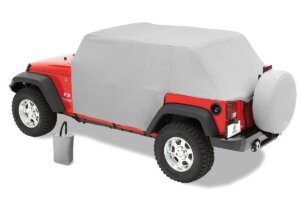
The Bestop All-Weather Trail Cover is a Jeep cab cover built to protect your cab, windshield, and interior from sun, wind, and dust while shedding passing rain and snow. It is the only Jeep cab cover with door-opening protection flaps, so you can reach in with the doors off and keep the elements out. Adjustable straps pull it snug, and it packs into an included stuff sack when you are ready to run open.

For a closer look at how the All-Weather Trail Cover installs and fits, watch Bestop’s overview:

Here is what makes it the go-to Jeep Wrangler rain cover for topless days:

  • Door-opening protection flaps: The only Jeep cab cover with them, so you can access the interior with the doors removed while weather stays out.
  • Cab, windshield, and interior coverage: Keeps sun, wind, dust, and passing rain off your seats, dash, and controls when the top is off.
  • Adjustable straps: Cinch the cover into a snug, secure fit so it stays put through wind and highway speeds.
  • Fits over other Bestop accessories: Works with your existing Bestop gear on the Jeep, so your setup stays as-is.
  • Included stuff sack: Folds down and stores compactly, ready to grab the moment the forecast turns.

One fitment note: the All-Weather Trail Cover is designed for a topless Jeep and is not meant to fit over a vehicle with the soft top already installed. It is available for the Wrangler JL and JK 4-door, the 2-door models, and the Jeep Gladiator, plus the TJ and YJ, with heritage coverage for the CJ.

The Permanent Fix: A Sealed Soft Top for Four-Season Driving

For the most complete everyday weather protection, a properly sealed soft top is the answer. A cab cover handles topless days and surprise weather. A soft top is a driving system engineered to seal against rain, wind, and cold season after season, then fold back to open air whenever you choose. Bestop builds soft tops for both the Jeep Wrangler and the Ford Bronco, and has been Jeep’s sole OEM soft top supplier since 1986.

That heritage shows up in the lineup, so you can match a top to the style and driving life you want:

  • Supertop family: The classic squareback with framed construction that stays attached to the vehicle, so you fold it back for open air and bring it up again when the weather turns. Explore the Supertop Squareback.
  • Trektop family: A modern frameless slantback with cleaner sightlines and a sleeker profile for drivers who want a contemporary look, including the Trektop Ultra Slantback.
  • Sunrider for Hardtop: A flip-back panel that replaces your Freedom Panels and opens overhead in seconds. It is a quick shot of open air above the front seats rather than a full top replacement.
  • eTop: The world’s only aftermarket powered soft top, opening and closing at one touch. The eTop brings effortless, everyday open-air freedom and is installed by a certified professional.

The build is where the everyday sealing comes from. Bestop soft tops use premium multi-layer fabrics, D.O.T.-approved tinted vinyl windows (40-mil or 30-mil depending on the product), and YKK zippers with heat-sealed seams. Every one is manufactured in the industry’s only OEM-certified soft top factory in North America. Bestop has refined that engineering since 1954, more than 70 years of soft tops. For the Bronco, Bestop is an OEM partner building authorized aftermarket products to Ford OEM standards, so the same testing and fit carry across platforms.

Fitment: 2-Door, 4-Door, and Every Wrangler Generation

Fitment is not one-size-fits-all. Bestop covers and tops are engineered per vehicle and body style, so a Jeep Wrangler waterproof cover for a 2-door setup differs from its 4-door counterpart, and every generation has its own pattern. A 2-door and a 4-door Wrangler have different cab lengths and roll-bar geometry, which is exactly why the right cover fits snug instead of flapping. Always confirm the exact part for your rig before you buy.

Bestop’s All-Weather Trail Cover platforms cover the modern and classic Wrangler lineup:

  • Wrangler JL (2018 to current), 2-door and 4-door
  • Wrangler JK (2007 to 2018), 2-door and 4-door. Browse the full Wrangler JK soft tops and accessories range.
  • Wrangler TJ (1997 to 2006)
  • Wrangler YJ (1987 to 1995), the platform behind searches for a Jeep YJ waterproof cab cover
  • Jeep Gladiator (2020 to current)
  • CJ heritage coverage for classic builds

Because door count and generation change the fit, confirm your exact match with Bestop’s Year/Make/Model (YMM) fitment tool, or reach out to Bestop customer service. That is the authoritative way to land the right cover or top for your specific Jeep the first time.

Choosing the Right Cover for Your Situation

The best cover is the one that fits how and where you drive. A quick way to decide: match your most common scenario to a solution below. A cab cover suits topless days, a soft top suits everyday driving, and many owners keep both to stay ready for any sky.

  1. You run topless on the trail and want quick rain protection. Reach for the All-Weather Trail Cover. It packs into its stuff sack, deploys when the sky turns, and keeps your interior covered without reinstalling a full top.
  2. You are a daily driver who wants dependable all-season coverage. Choose a sealed soft top from the Supertop or Trektop family, engineered to drive through rain, wind, and cold and fold back for open air on demand.
  3. You park outside for long stretches between drives. A full-vehicle car cover shields the whole stationary Jeep during storage, then comes off when it is time to roll again.
  4. You drive an older YJ or TJ. Bestop builds All-Weather Trail Covers and soft tops for those platforms, so classic Wranglers get the same weather-ready coverage as the newest JL.
  5. You want interior access with the doors off. The All-Weather Trail Cover’s door-opening protection flaps let you reach in and grab gear while weather stays out, the only Jeep cab cover with that feature.

Materials, Care, and Making It Last

Great weather protection comes down to the fabric, and Bestop soft tops use three current materials, each with its own feel and best fit. Black Diamond is a marine-grade vinyl at 28 oz with a smooth, glossy finish, ideal for trail rigs and warm climates. Sailcloth is a 28 oz three-layer fabric with a matte, canvas-like texture for balanced comfort. Premium Twill is a 30 oz triple-layer with a rich textile weave, the go-to for daily drivers and all-season builds.

Caring for your cover or top keeps it performing for the long haul. A few simple habits go a long way:

  • Clean and protect with Bestop products: Use Bestop cleaner and protectant to keep fabric and windows in top shape and help the material shed weather.
  • Store your cab cover in its stuff sack: Keeping the All-Weather Trail Cover in its included sack protects it between trail days and keeps it ready to grab.
  • Handle windows with care: The D.O.T.-approved tinted vinyl windows stay clear and flexible when cleaned gently and kept free of grit.

For coverage details, check Bestop’s official warranty resources, and lean on the Soft Top Material Comparison page when you want to weigh fabrics side by side.

Weather should never decide whether you get to enjoy your Jeep. Whether you keep an All-Weather Trail Cover ready for surprise storms on topless days or step up to a sealed soft top for four-season freedom, there is a Bestop solution built for how you drive. Explore the All-Weather Trail Covers collection and the Supertop, Trektop, Sunrider for Hardtop, and eTop families, and get your Wrangler ready for any sky, open-air on your terms.

Frequently Asked Questions About Waterproof Jeep Wrangler Covers

Quick answers to the questions Wrangler owners ask most when shopping for weather protection.

Is a Jeep Wrangler cover waterproof?

Fitted cab covers like the Bestop All-Weather Trail Cover are water-resistant weather protection: their multi-layer fabric resists rain, snow, sun, and dust and sheds water when strapped snug. For sustained, sealed protection while you drive, a full soft top such as the Supertop or Trektop is the better long-term answer.

What is the difference between a Jeep cab cover and a full car cover?

A cab cover, or trail cover, protects only the cab, windshield, and interior when your top is off, so it is ideal for surprise weather on the trail. A full car cover wraps the entire parked Jeep for long-term outdoor storage. Choose based on whether your top is off or your Jeep is parked.

What is the best waterproof cover for a Jeep Wrangler when the top is off?

The Bestop All-Weather Trail Cover is purpose-built for a topless Jeep. It is the only Jeep cab cover with door-opening protection flaps, so it works with trail doors, tube doors, or no doors. Adjustable straps deliver a snug fit, and it packs into an included stuff sack.

Does the Bestop All-Weather Trail Cover fit over other accessories or with doors off?

Yes. The All-Weather Trail Cover is designed to fit over other Bestop exterior accessories, and its door-opening protection flaps let you reach the interior when trail doors, tube doors, or no doors are installed. Note it is not designed to fit over a Jeep that still has its soft top on.

Do waterproof covers fit a 2-door and 4-door Wrangler the same way?

No. Bestop tops and covers are engineered per vehicle and body style, so 2-door and 4-door Wranglers use different fitments. Bestop offers All-Weather Trail Covers for Wrangler JL, JK, TJ, and YJ plus the Gladiator. Confirm your exact fit with the Year/Make/Model tool before ordering.

Can I put a cover over my Jeep while the soft top is installed?

The Bestop All-Weather Trail Cover is not designed to fit over a vehicle with the soft top installed; it protects the cab when the top is off or at home. If you want to cover a fully assembled Jeep parked outdoors, choose a full-vehicle car cover sized for your model instead.

What is the most weatherproof permanent solution for a Wrangler?

A properly sealed soft top is the most complete everyday weather protection. Bestop, Jeep’s sole OEM soft top supplier since 1986, builds the Supertop and Trektop families with premium multi-layer fabric, tinted windows, and YKK zippers with heat-sealed seams for four-season driving on the Wrangler and Ford Bronco.

How do I keep my Jeep’s interior dry when the top and doors are off?

Keep a cab cover in your rig. A Bestop All-Weather Trail Cover stores in its own stuff sack and installs in minutes, so when weather rolls in you can shield the seats, dash, and interior fast, far quicker than reinstalling a full soft top and zipping in every window.

Jeep Wrangler Soft Top Maintenance: The Complete Care Guide

Key Takeaways

  • Jeep Wrangler soft top maintenance means inspecting the top, keeping frame hardware clean and snug, lubricating zippers and seals, re-tensioning loose fabric, and storing the top properly, not just washing it.
  • Lubricate soft top zippers with a purpose-made zipper cleaner and lubricant after clearing out grit, and avoid WD-40 or wet lubricants that attract dirt and gum up the teeth.
  • Keep your soft top from leaking by inspecting and treating the seals and seams regularly and re-tensioning the fabric so water sheds the way the top was engineered to.
  • You can leave a soft top on through winter if you keep the seals clean, warm the cabin before operating stiff windows, and rinse away road salt promptly.
  • Store a removed soft top clean and fully dry, flat or loosely rolled without tight creases, in a cool, dry place away from sunlight under a breathable cover.

There is a kind of freedom that only arrives with open air: the breeze overhead, the day pouring in, the road feeling closer than it does from behind glass. A Bestop soft top is what puts that moment within reach whenever you want it. Jeep Wrangler soft top maintenance is how you protect that feeling for the long haul. It comes down to small, repeatable habits that keep your top sealing cleanly, operating smoothly, and looking right season after season. This guide covers the care that goes beyond a routine wash, so open air stays part of your everyday.

What Jeep Wrangler Soft Top Maintenance Actually Means

How do you maintain a Jeep Wrangler soft top? You keep it clean, inspect it regularly, and give its moving and sealing parts a little attention as the seasons turn. That means lubricating zippers and seals, keeping frame hardware snug, re-tensioning the fabric when it loosens, and storing the top properly when it comes off.

Think of Jeep soft top care as a rhythm rather than a chore. Some of it happens whenever you wash, some of it lands with the change of seasons, and some of it you simply do when an inspection tells you it is time. Washing is the foundation, and it has its own best practices (touchless or manual wash only, and steering clear of automatic brush washes and high-pressure spraying). We cover that in detail in our dedicated soft top cleaning guide, so here we focus on everything that comes after: inspection, hardware, lubrication, tensioning, seams, and storage. Together these habits are what keep an open-air setup feeling seamless year after year.

Inspect Before You Maintain


How do you inspect a soft top for wear? Work top to bottom in good light, run your hands over the whole assembly, and look for the early signs before they become leaks or hard-to-operate windows. A five-minute walk-around every so often tells you exactly where to spend your care time.

Fabric and Stitching

Look across the panels for thinning, fading, or abrasion where the fabric rubs against the frame or sport bars. Check the stitched seams for loose threads or gaps in the thread line, and press gently along high-stress corners where tension concentrates. Catching a weakening seam early keeps a small fix from becoming a tear.

Windows and Seals

Inspect the vinyl windows for hazing, deep scratches, or stress marks near the zippers and folds. Along the door surrounds and header, check that the seals and weatherstrips still sit flush and feel supple rather than dry or flattened. Seals that seat cleanly are what keep wind and water where they belong.

Frame, Hinges, and Hardware

Open and close the top through its full motion and watch how the frame tracks. Look for hinges that bind, latches that no longer seat with a clean bite, and any fastener that has backed off. Note any spot where metal meets fabric so you can protect both.

Frame and Hardware Care


The frame is the quiet workhorse of your soft top, and a little attention keeps it operating the way it should. Wipe down the hinges and pivot points to clear away grit, then work the top open and closed to feel for smooth, even motion. A dry, dirt-free pivot moves better and wears slower than one packed with trail dust.

Latches deserve a close look because they carry the seal. Make sure each one seats with a firm, positive bite and that its contact surface is clean. Where the frame and sport bars meet the fabric, keep those contact points clean and free of debris so the top is not riding on grit every time you drive.

To guard against corrosion, keep the frame dry after wet trips and give exposed metal a periodic wipe-down, paying attention to any bare or scuffed areas. Keep fasteners snug, checking the bolts and brackets that hold bows and brackets in place, since normal driving and flexing can gradually loosen them. Snug, clean, and dry hardware is the foundation everything else sits on. When you replace or protect these surfaces, choose finishes and materials suited to weather exposure so they hold up through all-season driving.

Zipper and Seal Lubrication

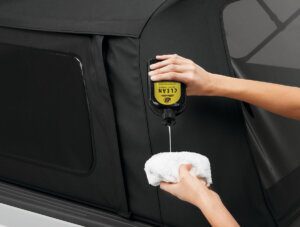
What can I use to lubricate soft top zippers? Reach for a purpose-made Jeep soft top zipper lubricant such as the Bestop Soft Top Zipper Cleaner & Lubricant, which is formulated for the coated zippers on Jeep and Ford Bronco soft tops. Start by cleaning first: rinse and wipe the zipper teeth to clear sand and grit, because grinding a dry, dirty zipper is the fastest way to wear it out. Once the teeth are clean and dry, apply the lubricant along the track, work the slider back and forth to spread it evenly, and wipe away any excess so nothing is left to attract dust.

Skip household sprays like WD-40 and other wet lubricants, since oily films collect dirt over time and can leave the zipper grittier than before. A dedicated zipper cleaner and lubricant keeps the action smooth without that buildup.

Give your seals and weatherstrips the same care. After cleaning, treat the rubber seals with a compatible protectant so they stay flexible and continue to seat flush against the body. Supple seals compress and rebound the way they were designed to, which is what keeps your cabin quiet and your soft top sealing cleanly in the rain.

For a visual walkthrough of cleaning and lubricating your top, watch our Top Talk care video:

Re-Tensioning and Seam Care

Re-Tensioning a Loosened Top

Soft top fabric naturally stretches and relaxes over time, so a top that once pulled drum-tight can start to feel slack. When that happens, re-tension it in a warm environment, since warmth lets the fabric relax and move into place instead of fighting you in the cold. Work evenly across the frame so tension is balanced side to side rather than pulled hard in one corner, and always follow the fit and adjustment steps in your specific top’s instructions. An evenly tensioned top seals better, flaps less at speed, and simply looks right.

Seam and Leak Prevention

Seams and seals are where most leaks begin, so give them a little proactive care. Keep the stitched seams clean and inspect them for any thread that has started to lift. If your top’s care instructions call for a seam sealer on the stitch lines, apply it as directed to keep water tracking over the seam rather than through it. Pair that with supple, well-seated seals and weatherstrips, and you close off the paths water uses to find its way inside.

Removing and Storing Your Soft Top for the Off-Season

When it is time to put the top away, how you store it decides what condition it is in when you bring it back. Start by cleaning the top and letting it dry completely, because folding away any trapped moisture invites mildew and musty odors. Give the vinyl windows and fabric plenty of time to air out fully before anything gets folded or covered.

When you fold, avoid tight, hard creases, especially across the vinyl windows, since sharp folds can leave permanent crease lines and stress marks in the vinyl. Instead, store the top flat or loosely rolled, keeping the windows relaxed and gently supported. Choose a cool, dry place away from direct sunlight, and drape it with a breathable cover that lets air move while keeping dust off. A plastic sheet or sealed bin traps humidity, so breathable is the word to remember. For more on protecting and storing your Jeep top, our comprehensive storage guide walks through your options. Stored this way, your top comes back out ready for open air rather than needing repairs.

Winter Care: Leave It On or Store It

When the cold sets in, you have two good options, and Jeep soft top winter storage is only one of them.

If you keep the top on through winter, a little routine keeps it happy in the cold. Keep the seals and weatherstrips clean and treated so they stay flexible instead of drying out and stiffening. Before you operate chilly, stiff vinyl windows, let the cabin warm up first, because cold vinyl is far less forgiving and flexing it warm helps prevent cracking. After driving on treated roads, rinse away road salt and slush promptly so it does not sit on the fabric, seals, or frame hardware. Our cold-weather driving prep guide has more for winter adventures.

If you would rather store the top for the season, remove it once it is clean and fully dry, then follow the flat-or-loosely-rolled, cool-dark-and-breathable approach from the section above. Either path works. The right one is simply the one that fits how you want to drive through the colder months.

When Maintenance Isn’t Enough: Repair vs. Replace

Good care extends a soft top’s life for years, and there still comes a point where a fresh top is the better move. Watch for windows that have yellowed or hazed past the point of seeing through clearly, zippers that have failed and no longer seat or run, fabric that has torn or worn thin, and frame legs or bows that have bent out of true. Small issues are often worth repairing, but when several of these stack up, a new top restores the fit, seal, and clean open-air experience you first fell in love with (our Jeep Wrangler soft top buyer’s guide walks through the choices).

When you are ready, Bestop builds soft tops for Jeep and Ford Bronco with the same engineering that made it Jeep’s sole OEM soft top supplier since 1986. The Supertop family offers the classic framed squareback that stays on the vehicle and folds back for open air. The Trektop family brings a modern slantback silhouette with cleaner sightlines. And if you run a hardtop, the Sunrider for Hardtop replaces your Freedom Panels and flips back in seconds for a quick taste of sky. Each is offered in Bestop’s soft top materials, from Black Diamond vinyl to Sailcloth to Premium Twill, so you can match the look and feel you want.

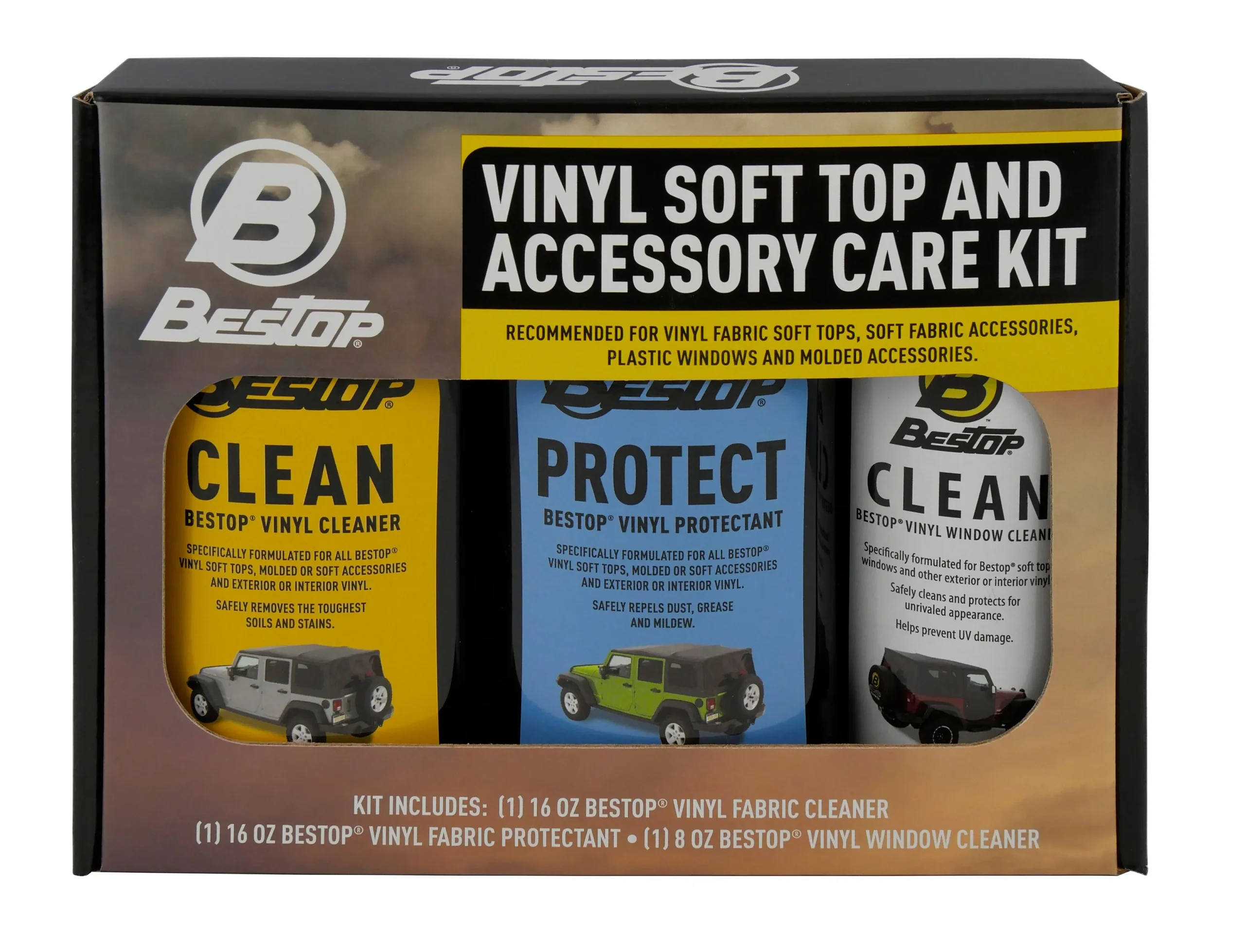
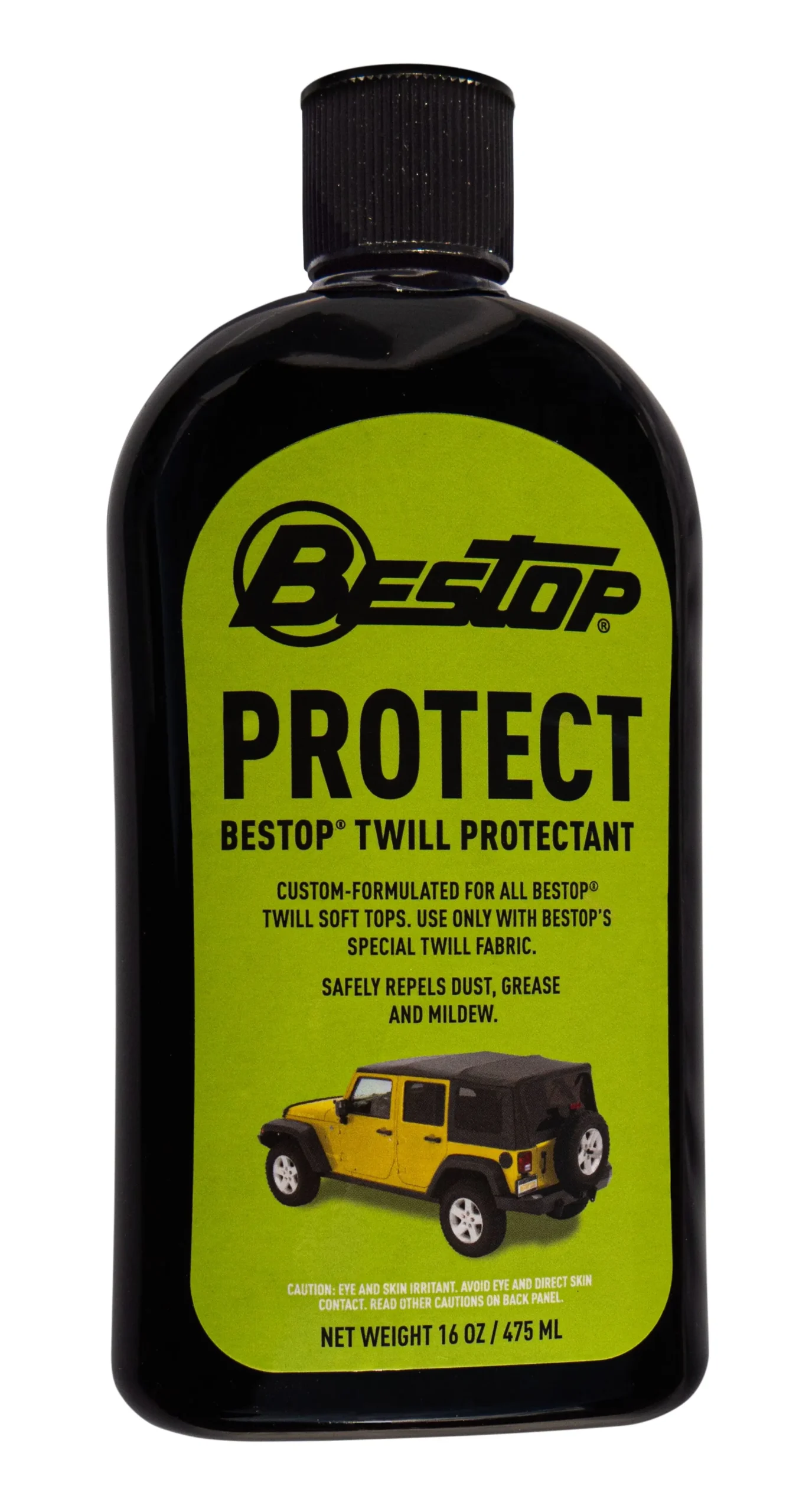
Your Jeep and Ford Bronco were built for open air, and a well-kept soft top is what lets you feel it whenever the mood strikes. Keep up these small habits, and open-air freedom stays a part of your everyday for years to come. When you are ready to refresh your setup or stock your care kit, explore the full range of Bestop soft tops and fabric care products, including the Soft Top Zipper Cleaner & Lubricant, Cleaner, Cleaner/Protectant Pack, Protectant for Twill Fabric, and Vinyl Window Cleaner. Then get back out there and enjoy the drive.

Frequently Asked Questions About Jeep Wrangler Soft Top Maintenance

Quick, practical answers to the questions Jeep Wrangler owners ask most about keeping a soft top sealing, operating, and looking its best.

How Often Should You Maintain a Jeep Wrangler Soft Top?

Fold maintenance into your normal routine rather than a fixed schedule. Inspect and clean the top whenever you wash your Jeep, apply a fabric-specific protectant after cleaning, and lubricate the zippers as soon as they start to feel stiff. Regular attention keeps seals, seams, and hardware working season after season.

What Is the Best Lubricant for Jeep Soft Top Zippers?

Use a purpose-made zipper cleaner and lubricant, such as the Bestop Soft Top Zipper Cleaner & Lubricant, and clean grit out of the teeth first. Avoid WD-40 and other wet lubricants that attract dirt and gum up over time. Wipe away any excess so the zipper glides without collecting debris.

Can You Take a Jeep Soft Top Through a Car Wash?

Bestop recommends a touchless or manual wash only. Avoid automatic car washes that use brushes and skip high-pressure washing: brushes can scratch the fabric and strip protective coatings, and high-pressure sprays can compromise the seals and force water into the cabin. Softer materials or gentle water jets are safest.

Can You Leave a Jeep Wrangler Soft Top On During Winter?

Yes. A well-maintained soft top handles winter fine. Keep the seals and weatherstripping clean, warm the cabin before operating stiff windows so you do not stress the zippers, and rinse away corrosive road salt regularly. If you would rather run a hardtop or go topless in spring, remove and store the top instead.

How Do You Store a Jeep Soft Top for the Off-Season?

Clean the top and let it dry completely to prevent mildew, then avoid tight creases that can crack the vinyl windows. Store it flat or loosely rolled in a cool, dry place away from direct sunlight and heat. A breathable cover or storage bag keeps dust and scratches off while it waits.

How Do You Keep a Soft Top From Leaking?

Leaks usually start at neglected seals, seams, or a loose-fitting top. Inspect the weatherstripping and window channels regularly, keep the seams clean, and re-tension a top that has loosened so water sheds the way it was engineered to. Addressing small gaps early prevents drafts, water intrusion, and interior damage.

How Do You Re-Tension a Loose Jeep Soft Top?

Soft tops stretch and settle with use, so a snug fit can loosen over time. Re-fit or adjust the top in a warm environment where the fabric is most pliable, then work it evenly across the frame following your top’s instructions. A properly tensioned top seals better and flutters less at highway speed.

How Long Does a Jeep Wrangler Soft Top Last?

Lifespan depends on the fabric, your climate, and how consistently you care for it. There is no single number, but routine inspection, cleaning, protectant, zipper lubrication, and smart storage all meaningfully extend how long a top keeps sealing and looking sharp. Neglect is what shortens a soft top’s life fastest.

Frameless Soft Top vs Bikini Top: How to Choose Your Open-Air Setup

Key Takeaways

  • A frameless soft top gives your Jeep or Ford Bronco a full enclosure using the vehicle’s sport bars for shape, while a bikini top shades the roof and front area and leaves the sides and back open to the air.
  • A bikini top is built for shade on warm, dry days, so it keeps the sun off your head, while a frameless full top with side and rear windows is the setup for driving through steady rain.
  • A frameless Bestop Trektop converts into a Safari Bikini when you remove the zipperless side and rear windows, so one top gives you full coverage and open-air shade.
  • A Safari Bikini is the extended-length version that shades the front seats and the rear seats, while a standard bikini top focuses coverage over the front area only.
  • For pure summer shade at the most approachable price, a bikini or Safari top wins, and for a top you drive year-round with a shade mode built in, a frameless Trektop is the versatile choice.

Open air is the reason you built the way you did. The breeze, the golden-hour drive, the spur-of-the-moment decision to pull the top back and let the day in. When you weigh a frameless soft top vs bikini top, you are really choosing how much of that open-air feeling you want and when. A frameless soft top gives you full coverage that seals up your Jeep or Ford Bronco and still opens on demand. A bikini top gives you partial coverage: shade over the front while the sides and back stay wide open. Both put you closer to the sky, and the right one depends on how you like to drive.

Frameless Soft Top vs Bikini Top: The Short Answer


A frameless soft top is a full-coverage top that wraps your Jeep or Ford Bronco with side and rear windows, using the vehicle’s sport bars for its shape instead of a bow-and-frame skeleton. A bikini top is a partial, shade-focused top that stretches over the roof and front area and straps to the sport bars, leaving the sides and back open. In short: frameless is your all-around top, and a bikini is your warm-weather shade. Explore the Trektop family of frameless soft tops and the Bikini and Safari lines to see both in action.

Feature Frameless Soft Top (Trektop Family) Bikini / Safari Top
Coverage Full enclosure with side and rear windows Partial: roof and front area (Safari extends over rear seats)
Attachment Header, sport bars, and body channels for a sealed fit Straps to the sport bars and header
Weather Protection Sun, rain, wind, and cold-weather driving Sun and shade on warm, dry days
Storage Stays with the vehicle; Sunrider panel flips back Rolls up small and stows in seconds
Best Season All-season, year-round driving Spring and summer
Price Tier Longer-term investment ($$ to $$$) Among the most affordable options ($)
Best For Drivers who want one versatile top with a shade mode built in Drivers chasing maximum open air and summer shade

What Is a Frameless Soft Top?

A frameless soft top is a full-coverage top that takes its shape from your Wrangler’s or Ford Bronco’s factory sport bars, with no separate bows or metal frame underneath. That clean, fastback (slantback) silhouette gives you tidy sightlines, a sealed cabin, and zippered side and rear windows for real weather protection. The Bestop Trektop family is frameless by design, and every top is engineered for a specific platform, whether that is the Wrangler JL, JK, TJ, Gladiator, or the Ford Bronco.

Where the frameless design shines is flexibility. A built-in Sunrider flip-back panel lets you fold the front section back for a quick sunroof feel on the fly. Remove the zipperless side and rear windows and the same top runs as a Safari Bikini for full open-air shade. The Trektop Ultra Slantback for the JL 4-door gives you four ways to drive from one top: fully enclosed, Sunrider open, Safari bikini, and fully open. The Trektop Glide Slantback brings that same frameless versatility to the JL 2-door.

Frameless tops install with your vehicle’s factory-style hardware and door surrounds for a sealed fit, and configurations vary by platform. To confirm exactly what fits your rig, use the Year/Make/Model (YMM) fitment tool before you order.

What Is a Bikini Top?

A bikini top, sometimes called a summer-shade top, is a partial top that stretches over the roof and front area of your Jeep to block the sun while the sides and back stay open to the breeze. It straps to the sport bars and header, rolls up small when you want it gone, and comes in a breathable mesh or in durable Black Diamond vinyl. Because of that simple, lightweight build, a bikini top is among the most affordable ways to get into open-air driving.

There are a few flavors to know. A standard bikini shades the front seats, while a Safari Bikini uses an extended length to shade the front and rear seats, which makes it a favorite for 4-door rigs and passengers riding in back. A Sun Bikini is designed to run alongside a soft or hard top, so you can add shade over the front and keep your main top ready. On the Ford Bronco, the equivalent partial top is called a Bimini, tuned to that platform.

Coverage and Weather Protection

A bikini top is built for sun and shade on warm, dry days, so it keeps the sun off while you drive with the sides and back open, and it is happiest under clear skies. A frameless full top is the setup for weather: its side and rear windows and sealed fit hold up to sun, rain, wind, and cold-weather driving. If your open-air plans run from a July errand to a rainy October commute, the frameless top covers the full range while the bikini stays the specialist for hot, clear afternoons.

Think about your climate and your typical week. In warm, dry regions where the forecast rarely surprises you, a bikini or Safari top delivers all the shade you want at a friendly price. If you see four real seasons or want the freedom to leave the top on and still open it up, a frameless Trektop gives you weather coverage plus a shade mode in one package.

Convertibility: One Top, Several Ways to Drive

Yes, a frameless soft top can be used as a bikini top. Remove the zipperless side and rear windows from a Bestop Trektop and it runs as a Safari Bikini, so you get full open-air shade from the same top that sealed your cabin last week. That built-in convertibility is the reason so many drivers land on a frameless top: it flexes with the day instead of asking you to pick one mode and live with it.

The wider Bestop lineup carries that same open-on-demand idea. The Sunrider flip-back panel on the Trektop family folds the front section back for an instant sunroof feel, and Sunrider for Hardtop flips back the Freedom Panels on a hardtop Wrangler in seconds as a quick-open upgrade rather than a full-top replacement. For the driver who wants open air at the push of a button, the eTop is the world’s only aftermarket powered soft top, opening and closing with one touch and installed by a certified professional. Whichever route you take, the goal is the same: more open sky, less planning.

Seasonality and Cost

Bikini tops are a spring-and-summer purchase, with demand climbing as the weather warms and drivers chase shade for the season. They sit among the most affordable options in the open-air lineup, which makes a Safari or Sun Bikini a low-commitment way to add summer style. A frameless full top is a longer-term investment that earns its keep across every season, since you drive it year-round and get a shade mode built in.

Material choice shapes both feel and cost. Bestop offers three soft-top materials: Black Diamond, a marine-grade vinyl in the value tier; Sailcloth, a distinct three-layer fabric with a matte, canvas-like texture; and Premium Twill, a 30-oz triple-layer premium fabric with the richest look and quietest ride. Bikini tops commonly come in mesh or Black Diamond vinyl, while frameless Trektops are offered in premium fabrics. See the full Jeep soft top material comparison to match a material to your climate and budget.

Which Should You Choose?

Choose a bikini or Safari top if your driving lives in warm, dry weather and open air is the whole point: maximum breeze, minimal weight, and a friendly price for the summer season. Choose a frameless Trektop if you want one top that carries you through every season and still folds down to a bikini configuration when the sun is out. The best pick is the one that matches how you actually spend your time behind the wheel.

Your style plays in too. Some drivers love the pared-back, all-air look of a bikini and the way it signals summer the moment it goes on. Others want the versatility of a frameless top that seals up clean and opens on demand. If you prefer a classic squareback silhouette that folds back and stays attached, the framed Supertop Squareback is worth a look alongside the Trektop family. For a full walk through every option, the Jeep Wrangler soft top buyers guide lays out the whole range.

Explore Bestop Frameless and Bikini Tops

Bestop builds both sides of this comparison for your Jeep and Ford Bronco, so you can match the top to the way you drive. For full coverage with a shade mode built in, the Trektop family of frameless soft tops gives you the enclosure, the Sunrider flip-back, and the Safari Bikini conversion in one top. For pure summer shade, the Bikini and Safari lines put you in open air at an approachable price. Sunrider for Hardtop opens a hardtop rig in seconds, and the eTop brings powered, push-button open air for drivers who want the most seamless experience.

That range is backed by real engineering: Bestop has been the sole OEM soft top supplier to Jeep since 1986 and is an OEM partner to Ford Bronco, building to Ford OEM standards. Every top is designed and tested for a specific platform, from the Wrangler JL, JK, TJ, and Gladiator to the Ford Bronco. Browse the Trektop and Bikini lineups, then confirm the exact fit for your rig with the Year/Make/Model fitment tool so your next open-air setup is ready for the road.

Frequently Asked Questions About Frameless Soft Tops and Bikini Tops

Quick answers to the questions Jeep and Ford Bronco owners ask most when choosing between a full-coverage frameless soft top and a partial bikini top.

What Is the Difference Between a Frameless Soft Top and a Bikini Top?

A frameless soft top is a full top that encloses the whole cabin using your Wrangler’s sport bars for shape, with side and rear windows. A bikini top covers only the roof area over the front seats, leaving the sides and back open for shade, not weather protection.

Does a Bikini Top Protect Against Rain?

Not really. A bikini top is a summer-shade top designed to block sun and heat over the front seats, with open sides and an open back. It offers little protection from rain, wind, or cold. For real weather coverage you want a full frameless soft top like the Bestop Trektop.

Can a Frameless Soft Top Be Used as a Bikini Top?

Yes. That is the advantage of a Bestop Trektop. Remove the zipperless side and rear windows and the frameless top runs as a Safari Bikini, giving you open sides and back with shade up top. Zip the windows back in and you have full enclosure again. One top, several configurations.

What Is a Safari Bikini Top Compared to a Regular Bikini Top?

A regular bikini top shades only the front-seat occupants. A Safari Bikini top is extended in length so it also covers the rear seats, keeping everyone shaded on the trail. Bestop offers Safari Bikini and Sun Bikini styles in mesh or Black Diamond fabric for Wrangler platforms.

Which Jeep Top Is Best for Summer?

It depends on your climate. In warm, dry areas a bikini or Safari top gives maximum breeze and easy shade. If you want sun protection plus the option to close up when a storm rolls in, a frameless Trektop is the more versatile choice because it converts from full coverage to Safari Bikini.

Do You Need Factory Hardware for a Frameless Soft Top?

Frameless tops use your Wrangler’s sport bars for shape rather than a separate frame, but many configurations do require factory-style door surrounds and a tailgate bar. Fitment varies by platform and model, so confirm your exact year, make, and model with Bestop’s fitment tool before ordering.

Jeep Soft Top Window Replacement: How to Restore Your View

Key Takeaways

  • You can replace individual Jeep soft top windows whenever the fabric deck is still sound, which restores your clear view for far less than buying a whole new top.
  • Bestop OE JL Replacement Windows are sold individually (rear or side) for the 2018 to 2026 Wrangler JL, while Window Replacement Sets refresh every panel at once on earlier Wranglers.
  • Match your replacement window to your top’s fabric and color, then choose clear glass or an 18% tint that meets US and European regulations.
  • Replacing a soft top window is a zip-in job with no drilling, and most people finish a single panel in under an hour using the included instructions.
  • Protect new vinyl by never dry-wiping it, using a dedicated vinyl window cleaner, and avoiding opening the rear window in freezing temperatures.

There’s nothing like dropping the windows on your Jeep and letting the day pour in. But scratched, cloudy, or cracked windows can make a top that still has plenty of life left look tired and worn out, and they blur the open-road view you love. Here’s the good news: a Jeep soft top window replacement usually gets you back to clear, crisp, open-air driving without the cost of a whole new top. If the fabric deck is still solid, you can swap the glass-clear vinyl and feel like you’re behind a brand-new top again. This guide, from Jeep’s sole OEM soft top supplier since 1986, walks you through when to replace, what to choose, and how to do it.

Do You Need to Replace the Window or the Whole Top?

You can replace individual windows whenever the fabric deck is still sound: the seams are intact, the color is true, and the frame holds tension the way it should. In that case, fresh windows restore the view for a fraction of a new top. Plan on a full replacement only when the fabric is torn or badly faded, or the frame is failing.

Windows take the hardest wear on any soft top. Vinyl scratches from dry-wiping, hazes under years of UV, and can crack when it’s flexed in the cold, all while the fabric around it stays perfectly serviceable. So before you shop for a whole new top, look at the deck itself.

  • Replace the windows when: the vinyl is cloudy, scratched, or cracked, but the fabric is still strong and true to color.
  • Replace the top when: the fabric is torn or sun-faded, seams are letting go, or the frame no longer holds shape and tension.

If the deck checks out, new windows are the smart, satisfying fix, and you keep the top you already trust.

Signs Your Window Needs Replacing

Your Jeep soft top windows frame every open-air moment, and clear panels keep that view honest whether you are topless on the trail or buttoned up through a storm. When the windows start to fade, the whole experience dims with them. Here are the signs it is time to bring the clarity back.

  • UV clouding or hazing: Years of sun can leave vinyl windows milky and dull, softening the view you love.
  • Fine surface scratches: Dry-wiping grit across the vinyl etches tiny lines that scatter light and blur the glass.
  • Cracks in the vinyl: Opening or folding windows in freezing cold can crack stiff vinyl, and cracks only spread from there.
  • Stiff or failing zippers: Sticky, separating, or seized zippers turn a quick open-air change into a chore.
  • Reduced night visibility: Hazing and scratches catch headlights and glare, dimming your view after dark.

If your fabric deck is still sound and sealing well, these signs point to a straightforward window swap rather than a new top. You restore the full view and keep the top you already trust.

Jeep Soft Top Window Options from Bestop

Bestop has been Jeep’s sole OEM soft top supplier since 1986, and that same engineering goes into the replacement windows that keep your open-air view clear. You can buy exactly what you need: a single window on its own, or a full set to refresh every panel at once. Browse the Jeep soft top window replacement sets to see what fits your rig.

OE JL Replacement Windows (Wrangler JL)

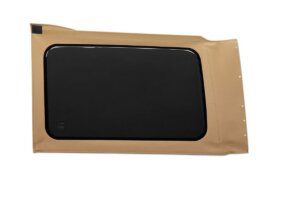
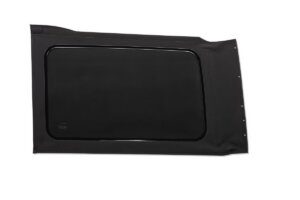
Built for the 2018 to 2026 Wrangler JL, these OE replacement windows are sold individually, so you can replace just the rear window or a left or right quarter (side) window without touching the rest. Sizing is offered for both 2-door and 4-door Jeeps, and you choose the look that matches your top.

  • Fabric surrounds: Black Twill, Tan Twill, and Black Diamond, so the new window blends into your existing top.
  • Clear or tinted: pick clear for the brightest view or an 18% tint that meets US and European regulations for a cooler, more private cabin.
  • Reuse your corner stiffener: the side quarter windows are designed to reuse the OEM stiffener from your original window, and step-by-step instructions are included.

Because the quarter windows require the OEM stiffeners from your original windows, hold onto the panels you’re removing until the new ones are installed.

Window Replacement Sets

If your windows have aged together, or you’re refreshing an earlier Wrangler, a full window replacement set brings every panel back to clear in one go. The sets reuse your existing factory or Trektop hardware, so you get a like-new view without buying a full top.

  • 40-mil D.O.T.-approved vinyl: tinted windows built to a real automotive standard for lasting clarity.
  • YKK zippers and heat-sealed seams: smooth operation and sealing you can count on season after season.
  • Multi-layer fabric with UV inhibitors: engineered to hold color and resist the sun that wore out your originals.

Match the Window to Your Top: Fabric, Tint, and Fit

The secret to a replacement that looks factory is matching two things: fabric type and color. Pair Black Twill with a Black Twill top, Tan with Tan, and Black Diamond vinyl with a Black Diamond top, then decide between clear and 18% tint. Get the fabric, color, and sizing right and the new panel disappears into the top you already own.

From there, it comes down to which window and which body style. Use the comparison table below as your quick reference, and keep these distinctions in mind:

  • Side (quarter) vs. rear: the quarter windows sit on the sides and reuse your OEM corner stiffener, while the rear window is its own dedicated panel.
  • 2-door vs. 4-door: window sizing differs between body styles, so confirm your Jeep’s configuration before you order.
  • Clear vs. tinted: clear delivers the brightest, truest view; the 18% tint adds cabin cooling and privacy while meeting US and European regulations.
Material Type & Weight Finish Tier


Black Diamond Marine-grade vinyl, 28 oz PVC-coated polyester Smooth, glossy Value
Sailcloth 28 oz three-layer fabric Matte, canvas-like Mid
Premium Twill 30 oz triple-layer with butyl-rubber core Rich textile weave Premium

Understanding Bestop Fabric Tiers

Your replacement windows sit inside a fabric surround, so matching that material to your top keeps your Jeep looking like it left the factory. Bestop builds three current soft-top materials, each with its own feel and finish.

  • Black Diamond: Bestop’s marine-grade vinyl, a 28-oz PVC-coated polyester with a smooth, glossy finish; the value tier.
  • Sailcloth: A separate 28-oz three-layer fabric with a matte, canvas-like texture; the mid tier, first offered on the Wrangler TJ.
  • Premium Twill: A 30-oz triple-layer weave built around a butyl-rubber core, with a rich textile look and the best cold-weather flexibility; the premium tier.

Black Diamond is a vinyl and Sailcloth is a woven fabric, so the two are always distinct materials. When you order replacement windows, match the surround fabric and color to your top’s material using the soft top material comparison guide for a seamless, factory-matched result. When you’re ready to lock it in, the Year/Make/Model fitment tool confirms the exact window for your Jeep so the match is right the first time.

How Much Do Jeep Soft Top Windows Cost to Replace?

Replacing your Jeep soft top windows costs far less than buying a whole new top. A single damaged window is the most economical fix, while a full window replacement set refreshes every panel at once and reuses your existing hardware. Your final price depends on fabric choice, clear or tinted glass, and whether you handle the install yourself.

Because your top’s frame and fabric deck stay in place, you pay for glass and surround rather than a full rebuild. That keeps a window refresh within reach and gets you back to open-air driving sooner.

  • Single window: The most economical route when one panel is clouded or cracked and the rest are still clear.
  • Full replacement set: Refreshes all panels at once for a uniform look while reusing your existing hardware.
  • Fabric choice: Vinyl and twill surrounds carry different price points, so your material sets part of the cost.
  • Clear or tinted glass: Tint options can shift the price alongside the fabric you choose.
  • Installation: Doing it yourself keeps costs down, while professional installation adds labor.

For current pricing, check the replacement window product pages on bestop.com, and confirm the right panels for your rig with the Year/Make/Model fitment tool before you order.

How to Replace a Jeep Soft Top Window (Step by Step)

Replacing a soft top window is a zip-in job with no drilling, and most people finish a single panel in under an hour with the included instructions. You unzip the old window, transfer any hardware the new panel calls for (like the corner stiffener on quarter windows), zip in the replacement, and you’re back to clear open-air views. Here’s the flow.

  1. Park and prep. Work on a clean, dry top in mild temperatures so the vinyl stays flexible and easy to handle.
  2. Unzip the old window. Run the YKK zippers fully open and gently free the panel from the fabric surround.
  3. Save your hardware. On quarter (side) windows, remove and keep the OEM corner stiffener from the old panel; you’ll reuse it in the new one.
  4. Position the new window. Align the replacement with the opening, matching the zipper tracks and corners before you start closing anything.
  5. Transfer the stiffener. Insert the reused OEM stiffener into the new quarter window per the included instructions.
  6. Zip it in. Work the zippers closed evenly around the panel so the vinyl seats flat and tension is even.
  7. Check the fit. Confirm the window lies smooth with no puckers, then cycle it open and closed once to make sure it moves freely.

Prefer to hand it off? Factory-trained professional installation is available if you’d rather have it done for you.

Keep Your New Windows Clear: Care Tips

Clear windows stay clear when you protect the vinyl from the things that wear it out: dry grit, hard flexing in the cold, and neglected zippers. A few simple habits keep your view crisp for seasons of open-air driving and help your next window last far longer than your last. For a full walkthrough, see our guide on caring for your Bestop soft top.

  • Never dry-wipe the vinyl: loose grit acts like sandpaper and leaves fine scratches, so rinse first.
  • Use the right cleaner: reach for a dedicated vinyl window cleaner and a clean microfiber cloth to lift dust without hazing.
  • Mind the cold: avoid opening the rear window in freezing temperatures, when the vinyl stiffens and can crack.
  • Care for the zippers: keep them clean and lubricated so they glide and seal for years.

When It’s Time for a New Soft Top Instead

Sometimes the deck is telling you it’s done: torn or faded fabric, seams giving out, or a frame that no longer holds shape. When the top itself is beyond a window swap, a fresh soft top brings back that first-day feeling, and Bestop builds one for the way you drive.

  • The Trektop family: a modern frameless fastback with clean sightlines, like the Trektop Glide for the Wrangler JL, for drivers who want a sleek, contemporary profile.
  • The Supertop family: the classic framed squareback that stays on your Jeep and folds back, like the Supertop Squareback for the Wrangler JK, with the broadest fitment across JL, JK, and TJ.
  • Sunrider for Hardtop: for hardtop owners, the Sunrider for Hardtop replaces the Freedom Panels and flips back in seconds for quick open-air moments.
  • Trektop Slantback for Ford Bronco: the same Bestop engineering, built to Ford OEM standards, brings open-air freedom to current-gen Bronco drivers with the Trektop Slantback for Bronco.

Bring Back Your Clear, Open-Air View

Your Jeep was built for open air, and a cloudy window shouldn’t be the thing standing between you and it. When the fabric deck is still strong, fresh windows are the fastest way back to that crisp, wide-open view, whether you replace one panel or refresh the whole set. Explore Bestop’s window replacement sets and OE replacement windows to find the fabric, color, and tint that match your top, then run your Jeep through the Year/Make/Model fitment tool to confirm the exact window before you order. Clear views and open roads are waiting.

Frequently Asked Questions About Jeep Soft Top Window Replacement

Quick answers to the most common questions about replacing the windows on your Jeep Wrangler soft top.

Can You Replace Just the Rear Window on a Jeep Soft Top?

Yes. On the Wrangler JL, Bestop OE Replacement Windows are sold individually, so you can replace only the rear window, only a side (quarter) window, or all three. If your fabric deck is still in good shape, replacing a single window restores your view without buying a whole new top.

Can You Buy Jeep Soft Top Windows Individually or Only as a Set?

Both. Bestop OE JL Replacement Windows come as individual pieces (rear, left quarter, right quarter, in 2-door or 4-door sizing). For earlier Wranglers, Window Replacement Sets bundle the rear and two side windows together. Buy singles for one damaged window, or a set to refresh all the glass at once.

Do Replacement Windows Have to Match My Top’s Fabric?

Yes, match the window to your top’s fabric and color for a factory-correct look and fit. Bestop offers replacement windows in Black Diamond vinyl, Tan Twill, and Premium Black Twill. Confirm your top’s material first, then choose the matching window so the finish and hardware line up cleanly.

Are Bestop Replacement Windows Tinted?

You can choose clear or tinted. Bestop OE JL Replacement Windows are available in both, and the tinted option uses an 18% tint that meets U.S. and European regulations while helping keep the interior cooler. Window Replacement Sets use 40-mil D.O.T.-approved tinted vinyl for durability and privacy.

How Do You Replace a Jeep Wrangler Soft Top Rear Window?

Park in the shade with the top up, clean and dry the fabric, then unzip the old window and remove it. Line up the new window, start the zipper carefully at one corner, and work it fully around without forcing it. For side windows, reuse the corner stiffener from the old window.

Why Do Jeep Soft Top Windows Crack or Scratch?

Vinyl windows cloud and scratch from years of dry wiping and rolling, and they can crack if opened in freezing temperatures when the vinyl is stiff. To protect new windows, clean them with a dedicated vinyl window cleaner and a microfiber cloth, and avoid opening the rear window in the cold.

Do Bestop Replacement Windows Fit the Factory Soft Top?

Yes. Bestop OE JL Replacement Windows are factory replacements built for the original Wrangler JL soft top, which makes sense given Bestop has been Jeep’s sole OEM soft top supplier since 1986. They zip into your existing fabric deck and reuse the OEM corner stiffeners, so the fit and look match the original.

Should I Replace the Windows Myself or Have Them Installed?

Zip-in window replacement is a manageable DIY job that needs no drilling, and printed instructions are included with each window. If you would rather not handle it yourself, Bestop’s factory-trained installation network can do it for you. Use the Year/Make/Model fitment tool first to confirm the right window for your Wrangler.

Top Jeep Soft Top Questions Answered by Bestop’s Experts

Key Takeaways

  • Bestop soft tops are engineered for four-season use with multi-layer fabrics, heat-sealed seams, and DOT-approved windows that keep you dry in rain, snow, and slush.
  • Choosing between a squareback (Supertop family) and a slantback (Trektop family) is a style decision first, then you narrow by features like fold-down capability or zipperless windows.
  • Premium Black Twill fabric delivers the longest lifespan and quietest ride, while Black Diamond or Black Diamond sailcloth fabric offers strong performance at a lower price point.
  • Regular cleaning with a dedicated soft top cleaner and protectant every 30 to 90 days can add years to your top’s life.
  • As the only aftermarket brand trusted as Jeep’s OEM soft top supplier for over three decades, Bestop brings factory-level fit and engineering to every product in the lineup.

There is something about dropping your top on a warm morning, feeling the wind hit, and realizing this is exactly why you bought a Jeep. That open-air feeling is what soft tops were built for. But if you are new to the soft top world, or even if you have been running one for years, questions come up. How do they handle rain? Will it survive winter? Which material is actually worth it?

We have been answering these soft top questions since 1954, when our founder Tom Bradley built the first easy-open Jeep top in a small Boulder, Colorado upholstery shop. Seven decades and an OEM partnership with Jeep later, our team still hears the same core questions from first-time buyers and seasoned trail runners alike. This guide brings those answers together in one place, straight from the people who engineer, test, and build more soft tops than anyone in the industry.

What Is a Jeep Soft Top and How Does It Work?
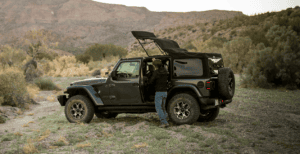
 

A Jeep soft top is a removable roof system made from engineered fabric stretched over a folding frame, designed to give you full weather protection when closed and open-air freedom when folded back or removed. It replaces or alternates with a fiberglass hardtop and typically includes a fabric deck, side and rear windows, door surrounds, and a folding hardware frame.

The basic concept is straightforward. A series of bows (the frame) arch over the roll bar area of your Jeep. The fabric stretches with precision over those bows and locks into channels along the sides and rear of the vehicle, creating a sealed cabin. Windows are integrated into the fabric panels and can be zipped, folded, or slid outdepending on the design. When you want open air, the top either folds back on its frame, slides into the cargo area, or comes off entirely.

What separates a modern soft top from the canvas flaps of decades past is improved fabric quality and engineering. Today’s soft tops use multi-layer fabrics with UV inhibitors, heat-sealed seams, DOT-approved windows, and precision-fit channels that create a seal tight cabin. The result is a roof that protects like a hardtop when you need it and disappears when you do not.

For a detailed look at how specific models compare, check out our soft top comparison page.

What Are the Different Types of Jeep Soft Tops?
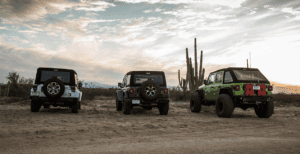
 

Jeep soft tops fall into four main style categories: classic squareback, fastback or slantback, partial-coverage soft tops like Sunrider for Hardtop, bikini, and bimini mesh tops, and then powered soft tops like the eTop. Each delivers a different style, varying levels of open-air accessibility, and their own unique driving experiences.

Squareback (factory-style) soft tops follow the traditional Jeep roofline. The Bestop Supertop family lives here and covers the widest range of vehicles and years, offering the familiar square silhouette with framed construction that folds back and stays on the vehicle. Variants include the Supertop Classic with YKK zipper windows and a rollable rear window, the Supertop Glide with zipperless slide-out panels, and the Supertop Ultra with patented Guide-Track Flow-Back retraction for easy solo operation.

Slantback (fastback) soft tops give your Jeep a sportier, more aerodynamic profile. The Bestop Trektop family defines this category with a frameless design and Sunrider open-air access. Options range from the entry level Trektop NX to the Trektop Ultra with its patented Lift Assist system for JL 4-door models. The Trektop Pro Hybrid (JK) is an industry first, combining a hard rear glass hatch with defroster and gas-assist struts to complement the  soft top open-air capability.

Bimini and halftops provide partial overhead shade without full enclosure. They are ideal for trail days or summer cruising when you want some sun protection but maximum airflow.

Sunrider tops offer a different kind of versatility. The Sunrider for Hardtop replaces the front freedom panels on your hardtop with a flip-back soft panel, giving you instant open-air access without having to remove the entire roof. It is a popular choice for owners who want to keep their hardtop but still enjoy a convertible feel on demand.

Powered soft tops represent the newest evolution in soft top design and is redefining what instant open-air freedom truly means. The eTop by Bestop is the world’s only fully automatic, powered soft top, giving you one-touch instant open-air access at the press of a button.

To compare all Bestop soft top models side by side, visit our comparison page.

How Do I Choose the Right Soft Top for My Jeep?
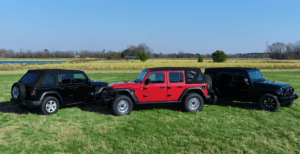
Choosing the right soft top comes down to several key factors: your Jeep’s year and model, whether you need a complete kit or just replacement fabric, and how you use your vehicle day to day.

Start with fitment. Soft tops are designed for specific Jeep platforms. A JL Wrangler (2018+) uses different mounting points and dimensions than a JK (2007-2018), TJ (1997-2006), or YJ (1987-1995). Some tops, like the Supertop NX and Trektop NX, offer the broadest fitment across generations. Others, like the Trektop Ultra, are designed exclusively for JL 4-door models.

Check your hardware. If your Jeep already has soft top hardware (the frame, bows, and channels), you may only need a Replace-A-Top fabric kit, which saves cost and simplifies installation. If you are converting from a hardtop or starting fresh, you will need a complete soft top kit with hardware included.

Understand the install. Many soft tops and replacement top fabric are designed exactly to fit within existing vehicle platforms and hardware to give the most secure, form fitting, look as well as function. While many vehicle owners consider themselves wrench and ratchet savvy, installing a soft top necessitates following instructions to the letter to ensure proper function and fit. Wind, noise, leaking, or various other post-install issues that surface are almost always a direct result of an improper installation.

Match your soft top to your lifestyle. Here is a quick guide:

  • Daily driver who wants maximum convenience: The eTop powered soft top or a Supertop/Trektop Ultra with Guide-Track retraction
  • Weekend adventurer who wants full convertibility: Supertop NX Glide or Trektop NX Glide with fold-down capability
  • Style-first buyer who loves the fastback look: Trektop NX for the slantback silhouette at an accessible price
  • Classic Jeep look with proven reliability: Supertop NX with its squareback design and rollable rear window
  • Hardtop owner who wants open-air flexibility: Sunrider for Hardtop for a flip-back convertible panel without removing your roof
  • Trail and summer shade: Bikini tops for maximum open-air exposure
  • All-season driver (JK) who wants hard rear glass convenience: Trektop Pro Hybrid

The squareback vs. slantback choice comes down to  style and identity preferences.. Pick the silhouette and look you love, then narrow it down by features.

Still not sure where to start? Our Soft Top Wizard walks you through a few short questions to help narrow the field, and our Year/Make/Model fitment tool confirms exactly which soft tops will fit your vehicle. For a deeper dive, browse our complete soft top buyer’s guide or contact our customer service team who can assist with any fitment questions.

Are Jeep Soft Tops Waterproof? Do They Leak?

Confidence in any climate or condition is part of what makes a soft top a true year-round choice. The answer is unequivocally yes. A properly installed and maintained soft top from Bestop  is waterproof and built for any season. Our soft tops use multi-layer, top quality fabric, heat-sealed seams, and precision-fit channels meticulously engineered to create a weather-tight seal around the entire cabin.

Here is what goes into keeping you dry:

  • Multi-layer fabric construction: Premium materials like our 30oz Black Twill use layered construction with built-in UV inhibitors and water-resistant coatings that shed rain on contact.
  • Heat-sealed seams: Rather than relying on stitching alone (which creates needle holes), critical seams are heat-sealed to prevent water intrusion at joints.
  • DOT-approved windows: 40-mil windows meet Department of Transportation standards for clarity, durability, and weather sealing.
  • Precision channel fit: Each top is engineered to lock into vehicle-specific channels with tight tolerances, minimizing gaps where water could enter.

The most common cause of leaks comes down to improper installation or proper fabric care that can lead to worn seals, or debris in the sealing channels. Keeping your channels clean and your seals conditioned goes a long way. If you do notice moisture, it is usually traceable to a specific point that can be adjusted or mitigated rather than a fundamental design issue.

For a deeper dive into how fabric technology impacts weather performance, see our material comparison guide.

Can You Drive a Soft Top Jeep in Winter?

Absolutely. Bestop soft tops are engineered and tested for four-season use. Thousands of Jeep owners run soft tops year-round in climates from the Colorado Rockies to the upper Midwest.

Modern soft top fabrics retain heat better than many drivers expect. The multi-layer construction acts as insulation, and the tight seal design minimizes potential air drafts. 

While modern day soft tops are designed and engineered to handle all weather scenarios, owners of soft tops should be aware of the potential impacts harsh weather conditions can have on fabric. Most issues can be avoided by common sense practices, but here are some useful, tips for practical cold-weather soft top use:

  • Warm the fabric before folding. In freezing temperatures, let your Jeep’s cabin heat warm the fabric for a few minutes before operating the top. Cold fabric is stiffer and harder on zippers and seals.
  • Keep zippers lubricated. A dedicated zipper lubricant prevents freezing and makes cold-weather operation smoother. Our zipper cleaner and lubricant is formulated for exactly this.
  • Clear snow and ice gently. Brush snow off with a soft broom or cloth. Never use an ice scraper on fabric or windows.
  • Condition seals before winter. A protectant application in fall keeps seals flexible through freeze-thaw cycles.

The old reputation of soft tops as “summer only” products comes from an era of basic canvas construction and loose, general fitment. Fabrics that stay tight under tension, seals that reduce wind whistle, and materials tested at highway speeds in sub-freezing conditions have changed the conversation entirely.

Soft Top vs Hardtop: Which Is Better for Your Jeep?

Neither is universally better. The right choice depends on how you use your Jeep, where you live, and what you value most in your driving experience.

Here is how they compare across the factors that matter most:

Factor Soft top Hardtop


Open-air access Fold, slide, or remove in minutes (or seconds with eTop and Sunrider) Requires removal of full top or lifting large quarter panels and storage
Weight Lightweight fabric and hardware significantly reduces vehicle overall weight, potentially , improving fuel economy and center of gravity Primarily made from fiberglass, sheet molded composite (SMC) or molded plastic layers, typically adds 100 to 150 lbs creating a  on the vehicle
Noise at highway speed Quieter than ever with premium fabrics and tight seam seals, but not silent. Modern soft tops (when installed properly) can perform as quite as factor hard tops, sometimes quieter based on the fabric type. Current vehicles (2007 to present) with modular hard tops typically experience the same or above levels as modern soft tops. Older vehicle model’s hard tops tend to be slightly quieter overall
Weather sealing Fully waterproof with proper installation and maintenance. Higher risk exists when soft tops are removed and stored and re-installed, depending on storage care and conditions. Current vehicles (2007 to present) with modular hard tops will have more connection points and seals where older vehicle hard tops are fully sealed
Security Tight seal connections make it more resistant to casual entry when closed and locked. Fabric can be cut (practical tips below) When windows are up and doors locked, hard top enclosed vehicles deter casual entry opportunities. Windows can be smashed
Cost Lower initial investment Higher initial cost
Versatility Multiple configurations from sealed cabin to fully open Sealed or fully removed, limited middle ground
Storage when removed Minimal footspace. Can be folded and stored Requires  roughly 5’x4’ storage space or 8’ garage height with a hoist

The biggest advantage of a soft top is freedom of choice. On your morning commute, you have a sealed, weather-tight cabin. On your weekend excursions, you drop the top in minutes and enjoy the ride the way it was meant to be experienced. That flexibility is why many Jeep owners who try a soft top never go back.

For a closer look at common soft top myths and why experienced owners keep choosing fabric, visit our dedicated page.

How Long Do Jeep Soft Tops Last?

A quality Jeep soft top can typically last three to five years with standard everyday use, premium materials can extend that lifespan well beyond with proper soft top care. The biggest factors are fabric quality, climate exposure, and how consistently you maintain the top.

Here is how the main fabric options compare on durability:

  • Premium Black Twill (30oz): The thickest, most durable option available. Twill resists UV degradation, stays taut longer, and delivers the quietest ride. Bestop’s Supertop NX in Twill is backed by one of the strongest warranties in the lineup. For full warranty details, visit our warranty page.
  • Sailcloth: The factory-equivalent material, offering solid durability and weather performance at a lower price point than Twill. A strong choice for owners who want proven performance without the premium investment.
  • Black Diamond vinyl (28oz): A budget-friendly option that performs well but has a shorter lifespan than fabric alternatives, particularly in high-UV environments.

Factors that can negatively impact the lifespan of a soft top include prolonged UV exposure without protectant, parking outdoors year-round in harsh climates, and neglecting regular cleaning. Factors that extend it include applying protectant every 30 to 90 days, parking in shade or a garage when possible, and keeping zippers lubricated and seals conditioned.

Bestop also offers replacement fabric kits (Replace-A-Top) that let you refresh your top using existing hardware, so when the fabric does reach the end of its life, you do not have to buy a complete new system.

Browse our full range of soft top cleaners and protectants to keep your investment looking and performing its best.

How Do You Clean and Maintain a Jeep Soft Top?

Clean your soft top every two to four weeks with a dedicated soft top cleaner, avoid automatic car washes with brushes, and apply a fabric protectant every 30 to 90 days. That routine alone will add years to the life of your top.

Here is a step-by-step cleaning process:

  1. Rinse the top with cool or lukewarm water to remove loose dirt, dust, and debris. Never start scrubbing a dry, dirty top.
  2. Apply a dedicated soft top cleaner (not dish soap, household cleaners, or degreasers, which can strip protective coatings). Work the cleaner in with a soft bristle brush using gentle, even strokes.
  3. Rinse thoroughly and let the top air dry completely before closing or folding.
  4. Clean windows separately with a dedicated vinyl window cleaner and a soft cloth. Standard glass cleaners contain ammonia and alcohol that cloud and crack vinyl over time.
  5. Lubricate zippers with a zipper-specific lubricant to keep them operating smoothly and prevent corrosion. This is especially important before winter.
  6. Apply fabric protectant once the top is clean and dry. Protectant restores UV resistance and water repellency that naturally diminishes with sun exposure.

For detailed window care instructions, see our guide on how to clean your soft top windows. For zipper maintenance, our zipper cleaner and lubricant is formulated specifically for soft top hardware.

Want the full care playbook? Read The care and feeding of your Bestop soft top.

For a visual walkthrough of the full cleaning process, watch our soft top care guide:

[Video: https://www.youtube.com/watch?v=UeOdiwEAR6U&t=2s]

Can You Take a Jeep Soft Top Through a Car Wash?

Use touchless (no-contact) car washes only. Never take a soft top Jeep through a car wash with spinning brushes or cloth strips.

Spinning brushes are designed for hard automotive paint, not fabric. They can scuff and abrade the top’s surface coating, scratch vinyl windows to the point of reduced visibility, pull at seams and edges, and grind embedded dirt into the fabric rather than removing it. One pass through a brushed car wash can cause more surface damage than months of trail dust.

Touchless car washes that use only water pressure and detergent are generally safe, though hand washing is always the best option. A garden hose, a soft bristle brush, and a dedicated cleaner give you more control and protect the fabric and windows from anything abrasive.

If hand washing is not practical every time, a touchless auto wash for the body followed by a quick wipe-down of the top and windows by hand is a solid compromise.

How Do You Install a Jeep Soft Top?

Installation difficulty depends on whether you are replacing fabric on existing hardware or doing a full changeover from a hardtop. A fabric-only replacement on existing hardware is a straightforward project most owners complete in one to two hours. A full hardtop-to-soft-top conversion takes longer depending on the soft top and work space.

Here is the key distinction:

  • Fabric-only replacement (Replace-A-Top): If your Jeep already has a soft top frame and hardware in good condition, you are simply swapping the fabric skin. Remove the old fabric, stretch the new one over the existing bows, and lock it into the channels. This is well within DIY range for most owners.
  • Complete soft top kit (new hardware + fabric): If you are converting from a hardtop or your hardware needs replacing, the kit includes the frame, bows, channels, and fabric. This involves assembling the frame, mounting it to the roll bar area, and then fitting the fabric. It is more involved but does not require any drilling, cutting, or permanent modification to the vehicle.

    Consider using our dealer locator online to find Bestop Authorized Installers in your area.

Best practices for installation:

  • Install above 72 degrees F. Fabric stretches more easily in warm conditions, giving you a tighter fit and making the channels easier to engage. Cold fabric is stiff and harder to work with.
  • Watch the install video first. Every Bestop product has a corresponding installation video that walks through the process step by step.
  • Do not force anything. If a channel is not engaging or a bow is not seating, recheck alignment before applying more pressure.

Visit our installation support page for model-specific guides and our full video library.

What Should You Do if Your Soft Top Is Damaged?

Most soft top damage can be repaired or addressed with replacement components rather than buying an entirely new top. Common issues include cloudy or scratched windows, stuck or broken zippers, and fabric wear or tears.

Here is how to handle each:

  • Cloudy or scratched windows: Vinyl windows naturally haze over time from UV exposure and cleaning. A dedicated window cleaner and polish can restore clarity in many cases. For windows beyond polishing, Bestop offers replacement window sets that install into your existing top.
  • Zipper issues: Zippers that stick, separate, or break are the most common soft top complaint. Often, a thorough cleaning and lubrication will restore function. If the zipper track itself is damaged, replacement window panels (which include new zippers) are available.
  • Fabric damage: Small tears or abrasion spots may be manageable with fabric repair kits. For larger areas of wear, a Replace-A-Top fabric replacement lets you put new fabric on your existing hardware at a fraction of the cost of a complete top.

The key advantage of Bestop’s component approach is that you refresh and repair rather than replace. Replacement parts mean a single worn element does not force you into buying an entirely new system.

Browse replacement soft tops and components to find what you need for your specific model.

What Is the Best Jeep Soft Top Material?

The fabric material you choose shapes how your top looks, sounds, and holds up over years of open-air driving. Premium Black Twill is the highest-performing soft top material available, offering the best combination of durability, noise reduction, and weather resistance. Sailcloth delivers strong, factory-equivalent performance at a lower price, and Black Diamond vinyl is a more affordable option with versatile application.

Here is how the three main materials compare:

Premium Black Twill (30oz) – Durability: Thickest fabric available, with superior UV and abrasion resistance – Noise reduction: The tightest weave produces the quietest cabin at highway speeds – Weather resistance: Multi-layer construction with built-in UV inhibitors – Best for: Owners who want the longest lifespan, quietest ride, and premium feel

Sailcloth – Durability: Factory-equivalent material with proven performance across millions of OEM installations – Noise reduction: Good performance, slightly more road noise than Twill – Weather resistance: Solid water shedding and UV protection – Best for: Owners who want dependable, factory-grade performance at a moderate price

Black Diamond vinyl (28oz) – Durability: Good for the price, but more susceptible to UV degradation over time – Noise reduction: Adequate, but not on the level of Twill or sailcloth – Weather resistance: Effective when new, degrades faster without consistent protectant use – Best for: Budget-conscious buyers or owners who plan to upgrade later

The material you choose has more impact on long-term satisfaction than almost any other factor. If you plan to keep your soft top for years, the investment in Twill pays for itself in longevity and daily comfort.

For a side-by-side breakdown, visit our material comparison guide.

How Much Does a Jeep Soft Top Cost?

Jeep soft top pricing ranges from a few hundred dollars for a fabric-only replacement to a few thousand dollars for more premium soft tops like the powered eTop.

Here is a general breakdown by category:

  • Replace-A-Top (fabric only): The most affordable path if your existing hardware is in good shape. These kits include new fabric, windows, and door surrounds that install onto your current frame.
  • Complete Supertop or Trektop kits (hardware + fabric): Mid-range pricing that includes everything you need for a full soft top system. These are the most popular choice for hardtop-to-soft-top conversions or owners replacing a worn complete system.
  • Premium and Ultra-tier tops: The Supertop Ultra, Trektop Ultra, and similar flagship products command a higher investment due to advanced features like Guide-Track retraction, Lift Assist systems, and 40-mil Twill fabric.
  • eTop (powered soft top): The highest price point in the lineup, reflecting the one-touch powered operation, integrated electronics, and engineering that goes into the world’s only aftermarket powered soft top.

When comparing prices, fabric, features, and function all factor into the potential lifespan and overall total cost of ownership. A premium Twill top that lasts five-plus years with a strong warranty can cost less per year than a budget option that needs replacing in two to three. Also consider whether you need hardware: if your existing frame is solid, a Replace-A-Top fabric kit saves significant cost.

Explore the full lineup of soft tops for Jeep and Ford Bronco to compare options for your specific model and budget.

Is a Soft Top Jeep Safe and Secure?

A soft top provides full protection from weather and road conditions. They are designed to factory standards to fit tight and seal securely when closed. Unfortunately, bad actors exist and the perception that soft tops lack in security, the fact is cutting through fabric, while difficult, is not impossible. That honesty matters, because security and peace of mind are important considerations when making the decision to transition to a soft top. 

Here is the reality: any vehicle can be targeted, and even hardtop windows are not truly unbreakable. A determined thief can get into any car,, which means the smart approach is prioritizing eliminating the reasons someone might try to break into your vehicle rather than relying on the material itself as a barrier.

Practical security tips for soft top Jeep owners:

  • Do not leave valuables visible. This is the single most effective security measure. If there is nothing to see, there is no incentive to cut.
  • Use lockable in-vehicle storage. Products like Tuffy security boxes bolt inside your Jeep and give you a locked compartment that stays even when the top is down or off.
  • Remove or hide electronics, bags, and gear before parking in public areas.
  • Consider your parking environment. A soft top in a well-lit, high-traffic area is at very low risk.

Many long-time soft top owners report that the freedom and lifestyle benefits far outweigh the minor shift in how they think about what they leave in the vehicle. It becomes a habit quickly, and most will tell you they have never had an issue.

Your Next Step

Every Jeep deserves the right top that matches your identity, and the right soft top solution  depends on your vehicle, your lifestyle, and how you want to experience the road ahead. Whether you are replacing worn fabric, converting from a hardtop for the first time, or upgrading to the convenience of powered operation, the answers above should give you the confidence to move forward.

Ready to find the perfect fit? Select Your Vehicle to browse soft tops, accessories, and care products matched to your exact Jeep year and model.

Frequently Asked Questions About Jeep Soft Tops

Here are quick answers to the most common questions Jeep owners ask about soft tops, from weather performance to daily care.

Are Jeep Soft Tops Waterproof?

Yes. A properly installed Bestop soft top is fully waterproof. Multi-layer premium fabrics, heat-sealed seams, and precision-fit sealing channels keep water out of the cabin. The most common cause of moisture is not the top itself but debris in the sealing channels or worn seals, both of which are easy to maintain.

How Long Do Jeep Soft Tops Last?

A standard soft top lasts three to five years with normal use. Premium materials like Bestop’s 30oz Black Twill can last well beyond five years when maintained with regular cleaning and protectant application every 30 to 90 days. Climate, UV exposure, and storage conditions also affect lifespan.

Can You Drive a Soft Top Jeep in Winter?

Absolutely. Bestop soft tops are four-season gear, engineered and tested for rain, snow, slush, and freeze-thaw cycles. Multi-layer fabrics retain heat effectively, and tight sealing systems minimize cold air drafts. Thousands of owners run soft tops year-round in harsh winter climates.

Can You Take a Jeep Soft Top Through a Car Wash?

Use touchless (no-contact) car washes only. Never take a soft top through a wash with spinning brushes or cloth strips. Brushes can scuff the fabric surface, scratch vinyl windows, and grind dirt into the material. Hand washing with a soft bristle brush and dedicated cleaner is always the safest option.

How Do You Clean a Jeep Soft Top?

Rinse with cool water to remove loose dirt, apply a dedicated soft top cleaner with a soft bristle brush, rinse thoroughly, and air dry. Clean windows separately with a vinyl-specific cleaner. Lubricate zippers regularly and apply fabric protectant every 30 to 90 days to maintain UV resistance and water repellency.

What Is the Best Jeep Soft Top Material?

Premium Black Twill (30oz) is the highest-performing option, delivering the longest lifespan, quietest ride, and strongest weather resistance. Sailcloth offers proven, factory-equivalent performance at a lower price. Black Diamond vinyl is the most affordable but has a shorter expected lifespan, especially in high-UV environments.

How Much Does a Jeep Soft Top Replacement Cost?

Pricing ranges from a few hundred dollars for a fabric-only Replace-A-Top kit (using existing hardware) to over two thousand dollars for premium powered tops like the Bestop eTop. Complete kits with new hardware fall in the mid-range. Factor in total cost of ownership, as premium materials last longer and cost less per year.

Is It Hard to Install a Jeep Soft Top?

A fabric-only replacement on existing hardware is a straightforward project most owners complete in one to two hours. A full changeover from a hardtop takes longer but requires no drilling on Bestop products. Install above 72 degrees F for the best fabric fit, and watch the model-specific installation video before starting.

What Is the Difference Between a Soft Top and a Hardtop?

A soft top is a removable fabric roof system that folds, slides, or lifts off for open-air driving. A hardtop is a rigid fiberglass roof that provides slightly better noise insulation and security but requires a hoist or help to remove. Soft tops offer more versatility, weigh less, and cost less than hardtops.

Is a Soft Top Jeep Secure?

A soft top is not designed as a physical security barrier, and fabric can be cut. The most effective security approach is eliminating the incentive: keep valuables out of sight, use lockable in-vehicle storage like Tuffy boxes, and remove electronics before parking in public areas. Most long-time soft top owners report zero issues.

What Are the Different Types of Jeep Soft Tops?

Jeep soft tops fall into four categories. Squareback (factory-style) tops like the Bestop Supertop family offer a traditional roofline. Slantback (fastback) tops like the Trektop family provide a sportier profile. Bikini and halftops give partial shade for open-air driving. Powered tops like the Bestop eTop offer one-touch operation.

How Do I Know Which Soft Top Fits My Jeep?

Soft tops are built for specific Jeep platforms: JL (2018+), JK (2007-2018), TJ (1997-2006), and YJ (1987-1995). Start by identifying your model year and generation, then check whether your existing hardware is compatible. Use the Year/Make/Model fitment tool in the bestop.com navigation to confirm exactly which tops fit your vehicle, or contact customer service for help.


Supertop vs. Trektop: Which Bestop Soft Top Fits Your Open-Air Life?

Key Takeaways

  • The Supertop is Bestop’s classic squareback soft top with a built-in frame that folds back and stays on your Jeep, making everyday open-air driving quick and convenient.
  • The Trektop is a frameless fastback (slantback) top with sleeker sightlines that builds around your factory roll bars, and higher variants fold all the way down for a full open-air feel.
  • Choose Premium Twill for the quietest, most cold-weather-friendly cabin, Black Diamond vinyl for value and warm climates, or Sailcloth as a balanced middle-ground fabric.
  • Both families include a Sunrider flip-back sunroof over the front seats, so you can open the sky in seconds without lowering the whole top.
  • Jeep Wrangler owners can choose either family, while Ford Bronco drivers get open-air freedom through the Trektop Slantback built to Ford OEM standards.
The best mornings start with a decision you barely have to think about: roof back, breeze in, the day suddenly bigger. When Jeep Wrangler and Ford Bronco owners weigh Supertop vs. Trektop, they are really choosing how that open-air freedom fits into everyday life. Both are Bestop soft-top families, and both are built to let you feel the outside whenever the mood strikes.

The difference comes down to the shape and the rhythm you want. The Supertop is the classic squareback that stays on your rig and folds back in a moment. The Trektop is the frameless fastback with sleeker lines. This guide helps you match the right family to your lifestyle.

Supertop vs. Trektop at a Glance

What is the difference between the Bestop Supertop and Trektop? The Supertop is a classic squareback with a built-in frame that stays on the vehicle and folds back for open-air driving. The Trektop is a frameless fastback (slantback) that builds around your factory roll bars for cleaner sightlines and a sportier profile.

Think of it as two paths to the same freedom. The Supertop keeps your top ready and attached for quick everyday open-air. The Trektop leans into style, with an angled rear and a lighter feel. The table below lines up the details, and the sections that follow show which everyday rhythm each one fits. You can also see the whole range on the Bestop soft top comparison hub.

Feature Supertop (Squareback) Trektop (Slantback)
Design Framed squareback with built-in bows Frameless fastback that uses the factory roll bars
Going open-air Folds back and stays attached to the vehicle Drop the sides and rear window; Glide, Ultra, and Pro Hybrid have sunrider feature entry Slantback removes completely
Rear profile Upright and roomy, more cargo height and headroom Angled fastback rear window, sportier and more aerodynamic look
Sunrider flip-back sunroof Yes Yes
Fabric options Black Diamond, Sailcloth, or Premium Twill (varies by variant) Black Diamond, Sailcloth, or Premium Twill (varies by variant)
Current variants Supertop Squareback, Ultra Squareback, Glide, Classic Squareback Trektop Slantback, Glide, Ultra, Pro Hybrid, Slantback for Bronco
Fitment Broadest in the lineup, including older Wrangler TJ Jeep Wrangler and Ford Bronco
Best for Daily open-air, stays-on convenience, cargo space Fastback style, lighter removable setup

The Supertop: Classic Squareback Freedom That Stays On

The Supertop is for drivers who want open air to be effortless and always within reach. It is the classic squareback that lives on your Jeep, so going open-air means folding the top back and rolling out. There is no big teardown to plan, just breeze on demand.

That framed construction is the heart of it. The built-in bows give the Supertop its upright squareback shape and let the whole top fold back and stay attached to the vehicle. You get a roomy squareback rear with generous cargo height and headroom, plus the broadest fitment in the lineup, reaching back to the older Wrangler TJ.

The current family covers a range of styles. The Supertop Squareback is a versatile soft top for Wrangler JL, JK, TJ, and YJ models, offering a modern take on the classic Jeep soft-top design. The Supertop Ultra Squareback steps up the fabric and finish. The Supertop Glide adds a sliding rear feature for easier cargo access. For vintage builds, the Supertop Classic Squareback fits the early Ford Bronco, Jeep CJ, Wrangler YJ, and Land Cruiser.

Best for: daily drivers who want quick everyday open-air and a top that stays on the rig, ready whenever the sky clears. Explore the full Supertop family to see fabrics and fitments.

The Trektop: Frameless Fastback Style

The Trektop is for drivers who want their open-air setup to look as good as it feels. It is the frameless fastback, built around your factory roll bars instead of a separate frame. That gives it a sleeker, sportier slantback profile and cleaner sightlines out on the road.

The design is all about flexibility. You can drop the sides and the rear window to open things up, or go further depending on your variant. The Trektop Glide, Trektop Ultra, and Trektop Pro Hybrid offer a convenient fold-back design for an open-air driving experience.

For a closer look at how the frameless Trektop installs and operates, watch Bestop’s walkthrough:

The entry Trektop Slantback takes a slightly different route: it is removed from the vehicle to go fully topless, so you get that wide-open feel with a lighter setup to store. Ford Bronco owners get in on the style too, since the Bronco soft-top option is the Trektop Slantback built to Ford OEM standards.

Best for: style-seekers who love the fastback look and want a lighter, removable top they can shape around the drive ahead. Browse the full Trektop family to compare variants.

Squareback vs. Slantback: How the Two Shapes Differ

The shape you choose sets the tone for the whole rig, and it comes down to squareback versus slantback. Both open up fully, so this is about the identity you want your Jeep or Bronco to wear.

The Supertop squareback stands upright at the rear, which opens up cargo height and headroom for gear, dogs, and road-trip loads. The Trektop slantback angles the rear window into a fastback line, for a sportier, more aerodynamic look that hugs the body. One says roomy and ready, the other says sleek and sporty. Both put the open sky over your head.

Fabrics: Black Diamond, Sailcloth, and Premium Twill

Your fabric shapes how the top feels every day, from cabin quiet to how it handles the seasons. Bestop offers three current soft-top materials, and each one fits a different rhythm. Every top is engineered and fitted to your specific vehicle, so the material works with a design made for your platform.

Black Diamond is Bestop’s proprietary marine-grade vinyl, a 28-oz PVC-coated polyester with a smooth, glossy finish. It is the value choice, at home on trail rigs and in warm climates.

Sailcloth is a 28-oz, three-layer fabric with a matte, canvas-like texture. It is available exclusively for Bestop Replace-a-Top fabric replacements and is not offered as a fabric option for Supertop or Trektop models.

Premium Twill is the 30-oz triple-layer material with a butyl-rubber core and a rich textile weave in true black. It is the quietest option and the most flexible in cold weather, making it the premium pick for daily drivers who live with their top year-round. Compare all three on the soft top material comparison page.

Sunrider and Other Open-Air Features

Open-air freedom is not only about the big moves. Both the Supertop and Trektop families include a Sunrider flip-back sunroof over the front seats, so you can catch sun and breeze at a stoplight without touching the rest of the top. It is the little everyday luxury that makes each drive feel open.

There is also a separate, standalone Sunrider for Hardtop for owners who run a hardtop. It replaces the Freedom Panels and flips back in seconds, adding open-air overhead without being a full top replacement.

Zoom out and the Bestop lineup goes further still. The eTop, the world’s only aftermarket powered soft top, opens and closes at the push of a button, showing just how modern and effortless open-air freedom can be. Wherever you start, there is a Bestop top built for how you drive.

Which One Should You Choose?

The right choice is the one that matches your daily rhythm, not a scoreboard. Start with how you want your open-air moments to feel, then let the details fall into place.

If you want quick everyday open-air with a top that stays on the rig, the Supertop is your family, and it shines in Premium Twill for the quietest, most comfortable daily cabin. If you are drawn to the fastback look and want a lighter, removable setup, the Trektop delivers that style. Want all-season comfort either way? Premium Twill brings the low noise and cold-weather flexibility for year-round driving. Hauling gear or heading out with the dog? The Supertop squareback opens up more cargo height in the back.

Both families are Bestop-engineered for real fit and sealing on your specific platform, so the top works the way it should from day one. Jeep Wrangler owners can go either direction, while Ford Bronco owners get the open-air experience through the Trektop. For a wider look at every style, the Jeep Wrangler soft top buyers guide is a helpful starting point. Whichever calls to you, confirm the exact fit for your Jeep or Bronco with the Year/Make/Model tool before you order.

Whichever way you lean, the payoff is the same: more open sky, more spontaneous drives, more of your life spent in the fresh air. The choice between the Supertop and Trektop is really a choice about your style and the rhythm of your days. The Supertop keeps classic squareback freedom on your rig and ready to fold back, while the Trektop brings frameless fastback style and a lighter, removable feel. Explore both the Supertop and Trektop families, and find the open-air experience that fits the way you drive.

Frequently Asked Questions About the Supertop and Trektop

Quick answers to the questions Jeep and Ford Bronco drivers ask most when choosing between Bestop’s two full soft-top families.

What Is the Difference Between the Bestop Supertop and Trektop?

The Supertop is Bestop’s classic squareback soft top with a built-in frame that stays on your vehicle, so it folds back against the tailgate in seconds and rides along even in a surprise shower. The Trektop is a frameless fastback (slantback) top with cleaner sightlines and a sportier profile, designed around your factory roll bars.

Which Is Easier to Put Up and Down?

For quick, everyday open-air moments, the Supertop has the edge: its frame lets you fold the top back and leave it on the Jeep. The Trektop trades that fold-back convenience for a sleeker look, and higher variants like the Glide and Ultra fold down fully while the entry Trektop is removed to go completely topless.

Can You Go Fully Topless With a Trektop?

Yes. The Trektop is built for open-air freedom: you can drop the sides and rear window, and the Trektop Glide, Ultra, and Pro Hybrid fold all the way down. The entry Trektop Slantback comes off completely to go fully topless. Both families also feature a Sunrider flip-back sunroof over the front seats for instant sky.

Does the Supertop Stay on the Jeep When Folded Back?

Yes. Because every Supertop uses a built-in frame, it folds back and stays attached to your Jeep rather than coming off entirely. That makes it easy to open up for a golden-hour drive and close again quickly if the weather turns, without removing or storing the whole top.

Which Bestop Soft Top Is Quieter and Better for Winter?

Fabric drives comfort more than the top style. Premium Twill, a 30-oz triple-layer fabric with a butyl-rubber core, is the quietest and most cold-weather friendly choice and is offered on premium tiers of both families. Black Diamond vinyl is the value option, and Sailcloth sits in between. See Bestop’s material comparison to match fabric to your climate.

What Is the Difference Between Squareback and Slantback?

Squareback describes the Supertop’s upright, roomy rear profile, which maximizes cargo height and headroom. Slantback describes the Trektop’s angled fastback rear window for a sportier, more aerodynamic silhouette. Both deliver full open-air functionality; the choice is about the look and cargo shape you want.

Black Diamond vs. Premium Twill: Which Fabric Should I Choose?

Black Diamond is a 28-oz marine-grade vinyl with a smooth finish and value pricing, ideal for trail rigs and warm climates. Premium Twill is a 30-oz triple-layer fabric that runs quietest and stays flexible in the cold, suited to daily drivers and all-season use. Both are engineered and fitted to your specific vehicle.

Do Both the Supertop and Trektop Have the Sunrider Feature?

Yes. Both families include a Sunrider flip-back sunroof over the front seats, so you can open the sky in seconds without lowering the full top. It is one of Bestop’s most-loved everyday open-air features and is separate from the standalone Sunrider for Hardtop, which replaces factory Freedom Panels.

Which Should I Choose for Daily Driving vs. Trail Use?

For daily drivers who want quick open-air moments and a top that stays on, the framed Supertop is a natural fit, especially in Premium Twill for quiet comfort. For drivers chasing a sleeker fastback look and a lighter, removable setup for trail days, the Trektop family delivers. Both are Bestop-engineered for real fit and sealing.

The Best Jeep JL Accessories: A Wrangler Owner’s Buyer’s Guide

Key Takeaways

  • Start with the upgrades you touch every day: an open-air top, interior protection for floors and seats, and a smart place to store your hardtop or doors when they come off.
  • The best soft top for a Jeep Wrangler JL depends on the open-air experience you want, from the flip-back Sunrider for Hardtop to the framed Supertop, the slantback Trektop, and the push-button eTop.
  • Aftermarket Jeep soft tops are worth it when they are engineered for your platform, and Bestop has been Jeep’s sole OEM soft top supplier since 1986.
  • A 2-door JL and a 4-door JLU take different tops, liners, and covers, so confirm every purchase with Bestop’s Year/Make/Model fitment tool before you order.
  • Store a removed JL hardtop overhead with a ceiling hoist, and keep doors and Freedom Panels protected in padded storage so doors-off days feel spontaneous.

Your Jeep Wrangler JL was built for open air, and the right upgrades let you feel it whenever you choose. Whether you drive a 2018 two-door or a 2026 four-door JLU, the best Jeep JL accessories turn an errand run into a golden-hour detour and a weekend into an adventure.

This buyer’s guide is a lifestyle-first roundup: we start with the open-air tops that define the JL experience, then move through interior protection, storage, doors, and trail-ready gear. Think of it as a router into the specific categories that fit your build, your climate, and the way you actually drive. Every recommendation points back to how you want your Jeep to feel, then to how it works, and finally to the details behind it.

What to Buy First for Your Jeep JL


Buy the accessories you interact with every day first: an open-air top, interior protection, and storage for the parts you remove. These upgrades change how your JL feels on every drive, and they protect your investment while you build toward bigger projects. Explore the full range of Bestop Jeep Wrangler JL accessories to see how the pieces fit together.

Here is a sensible priority order for most Wrangler JL owners:

  1. Open-air top: The soft top or flip-back panel is the heart of the JL experience, so choose the style that matches how often you want sky overhead.
  2. Floor liners: Mud, sand, and rain are part of Jeep life, and full-coverage liners keep the cabin ready for whatever the trail brings home.
  3. Seat covers: Protect factory upholstery from sunscreen, dogs, and gear while adding a look that fits your build.
  4. Storage and security: A place to stash your hardtop, doors, and daily items makes open-air driving feel spontaneous.
  5. Doors and windows: Soft doors, tube doors, and window options open up warm-weather driving on your schedule.

Work down the list as your budget allows. Each step makes the JL more livable, and none of them lock you out of future upgrades.

Open-Air Tops and Roof Options (Start Here)


The best top for a Jeep Wrangler JL is the one that matches the open-air experience you want most, from a quick flip-back panel to a fully powered roof. Tops are Bestop’s home ground, and they are the single upgrade that most changes daily life with a JL. Browse the full range of Jeep soft tops to compare styles side by side.

Are aftermarket Jeep soft tops worth it? They are when the top is engineered, sealed, and fitted for your exact platform. That fit is where Bestop’s history matters: the same testing and tolerances that go into OEM work carry into every aftermarket top. Below are the main JL top styles, framed around the feeling each one delivers rather than a spec-sheet contest.

Sunrider for Hardtop

The Sunrider for Hardtop replaces your JL’s Freedom Panels and flips back in seconds for instant sky over the front seats. It is a fast taste of open air for hardtop owners who want spontaneity on a commute or a coffee run, while keeping the hardtop on the vehicle. The Sunrider is a flip-back panel rather than a full top replacement, which makes it a friendly entry point into the open-air lifestyle. See how it works on the Sunrider for Hardtop category page.

The Supertop Family

The Supertop family is the classic squareback soft top: framed construction that stays on the vehicle and folds back for open-air driving. It offers the broadest fitment across Jeep platforms and a timeless silhouette that many owners associate with the Wrangler itself. Because the frame stays mounted, you get a familiar routine for going open and buttoning back up as the weather turns. Explore the Supertop squareback soft tops to find the right variant for your JL.

The Trektop Family

The Trektop family is the modern slantback: a frameless fastback profile with cleaner sightlines and a contemporary look. It suits owners who want a sleeker roofline and a distinctive open-air setup that reads modern on the street and on the trail. Higher Trektop variants fold down for full open-air driving, giving you flexibility in how far you go. Compare options across the Trektop slantback soft tops lineup.

The eTop

The eTop is the world’s only aftermarket powered soft top, and it opens or closes at the push of a button. Launched in 2024, it makes open-air freedom something you press, which is why it shines on everyday commutes, errands, and spur-of-the-moment detours.

The eTop stays with your JL, ready whenever golden hour arrives. It is built with nine-layer premium fabric and a neoprene headliner that reduces cabin noise by up to 5 dB on Jeep JL configurations. The eTop is priced at approximately $5,295.00, and it requires installation by a certified professional, so verify current pricing and installation details before you order. Discover the full experience on the Bestop eTop powered soft top page.

For a look at open-air driving with Bestop tops and accessories, watch this:

Bikini Tops and Sunshades

A Jeep Bikini top gives you shade and airflow at the same time, covering the front seats while leaving the sides and rear fully open. Mesh Bikini and sunshade options are a warm-weather favorite for owners who want sun protection with maximum breeze, and they pack down small when you want a bare frame. They pair well with doors-off driving for the most open experience your JL can offer. See the range of Jeep Bikini tops and sunshades to match your climate.

A quick word on materials. Bestop’s current soft-top fabrics come in three tiers:

  • Black Diamond: a marine-grade vinyl with a smooth glossy finish and a value price.
  • Sailcloth: a three-layer fabric with a matte, canvas-like texture that balances comfort and value.
  • Premium Twill: a triple-layer fabric with a rich textile weave and the quietest, most cold-flexible ride.

Individual tops offer a subset of these materials plus heritage finishes, so check the product page for what a given top actually carries. Here is the trust behind all of it: Bestop has been Jeep’s sole OEM soft top supplier since 1986, a relationship spanning more than three decades. It manufactures in the industry’s only OEM-certified soft top factory in North America, and that same engineering also goes into the products Bestop builds for the Ford Bronco, though this guide stays focused on the JL.

Interior Protection and Storage

The best interior accessories for a Jeep JL protect the surfaces you use hardest: floors, seats, and cargo area, plus a place to store the parts you remove. Open-air driving means weather and trail debris find their way inside, so interior protection keeps your cabin ready for the next adventure.

Floor Liners and Cargo Liners

Full-coverage floor liners are the first line of defense against mud, sand, snowmelt, and spills. They are shaped for the JL footwells and cargo area, and they rinse clean when the day is done. Match your two-door or four-door layout on the Jeep floor mats and cargo liners page.

Seat Covers

Seat covers protect factory upholstery from sun, sweat, sand, and paws while letting you refresh the cabin’s look. They are a favorite for dog owners, beachgoers, and anyone who treats their JL as a daily driver and a trail rig. Look for covers shaped to your JL’s exact seats and airbag layout so the fit stays clean and the safety systems stay unobstructed. Browse fits and styles in Jeep Wrangler seat covers.

Storage and Security

Store a removed JL hardtop overhead with a ceiling hoist, and keep doors and Freedom Panels in padded storage so doors-off days stay spontaneous. Where do you put the hardtop and doors when they come off? A garage-ceiling hoist lifts the hardtop up and out of the way to reclaim floor space, while padded organizers protect doors, panels, and gear. Onboard organizers and lockable storage also keep daily items tidy and out of sight. Explore hoists, organizers, and lockboxes in Jeep storage and security.

Doors, Windows, and Mirrors

Doors-off driving is one of the JL’s signature freedoms, and the right doors, tube doors, and window options let you choose your level of open air. Soft doors and tube doors trim weight and open up the cabin for warm-weather cruising, while adjustable window setups let you fine-tune airflow and weather protection through the seasons. Mirror relocation solutions help you stay road-legal and aware when the factory doors come off. See the options in Jeep doors and windows, and confirm any doors-off setup meets your state’s requirements before you drive.

Exterior and Trail-Ready Upgrades

Exterior upgrades round out a JL build, covering protection, traction, visibility, and recovery for trail days. Bestop focuses on open-air tops and accessories, so treat the categories below as a neutral overview to help you plan the rest of your build with other specialists.

  • Fender flares: Wider flares add coverage for larger tires and give the JL a more aggressive stance; choose based on the tire size and look you are after.
  • Bumpers and tire carriers: Steel or aluminum bumpers support recovery points and accessories, and a reinforced carrier helps when you upsize the spare.
  • Lighting: Auxiliary lighting improves night and trail visibility; sister brand Baja Designs offers premium LED light bars for owners who want a top-tier setup.
  • Recovery and air: A recovery kit, traction boards, and a portable air compressor round out trail-day preparedness for airing down and back up.
  • Spare tire covers: A fitted cover protects your spare and adds a finishing touch to the rear; browse Jeep spare tire covers.

Tires, lifts, and suspension are big decisions best made with a wheel-and-tire specialist who can match clearance to your goals. Plan those around the open-air setup and protection you have already dialed in.

2-Door JL vs. 4-Door JLU: Fitment Notes

A 2-door Jeep Wrangler JL and a 4-door JLU take different tops, liners, and covers because their body lengths and cabin layouts differ. Soft tops, floor liners, seat covers, and storage solutions are engineered for a specific platform and body style, so a part made for one will not carry over to the other. Bestop designs each top for a specific vehicle and body type, which is why fit, sealing, and durability hold up over time.

For Jeep Wrangler JL 2-door accessories, look for parts labeled specifically for the two-door body, and do the same for the four-door JLU. The authoritative way to confirm any purchase is Bestop’s Year/Make/Model fitment tool, which matches a product to your exact JL. The Soft Top Wizard is helpful as a high-level orientation tool, but treat the YMM tool as the final word on fit.

How to Choose the Best Jeep JL Accessories

Choose your Jeep JL accessories around the open-air experience you want, then layer in climate, daily-versus-trail use, and confirmed fitment. A short framework keeps your build focused and your budget working for you.

  • Start with lifestyle: Decide how often you want the top open, then pick the top style that makes that easy on your schedule, from a flip-back Sunrider to a push-button eTop.
  • Factor in climate: Warm-weather drivers may love a Bikini top and lighter fabric, while all-season owners often prefer Premium Twill for quieter, cold-flexible driving.
  • Weigh daily versus trail: Daily drivers prioritize interior protection and quiet fabrics, while trail rigs lean on durable materials, storage, and recovery gear.
  • Protect what you use hardest: Add floor liners and seat covers early so the cabin stays ready for mud, sun, and dogs.
  • Confirm fitment: Match every part to your two-door or four-door body with Bestop’s Year/Make/Model fitment tool before you buy.
  • Check the details: For warranty questions, refer to Bestop’s official warranty resources rather than relying on general summaries.

Build in the order that fits your life. Each upgrade should bring you closer to the open-air Jeep you pictured when you bought it.

The best Jeep JL accessories are the ones that unlock more of your life, starting with the open-air top that makes every drive feel like freedom, then the protection and storage that keep your Wrangler ready for the next detour. Explore Bestop’s full JL lineup, from soft tops and the eTop to interior protection, storage, and doors, and picture how each piece fits the way you want to drive. When you are ready, dive into the Bestop Jeep Wrangler JL accessories hub and confirm fit with the Year/Make/Model tool, then build the open-air Jeep that fits your story.

Frequently Asked Questions About Jeep JL Accessories

Quick, direct answers to the questions Jeep Wrangler JL owners ask most when planning their build.

What Are the Best Accessories for a Jeep Wrangler JL?

The highest-impact JL accessories start with how you experience the vehicle: an easy-opening top like the Bestop Sunrider for Hardtop or a full Supertop or Trektop soft top, then interior protection (floor liners, seat covers), smart storage, and a spare tire cover. Prioritize open-air freedom first, then comfort and protection.

What Should I Buy First for My Jeep JL?

Start with the accessory you will use every day. For most owners that is an easier open-air setup, such as the Sunrider for Hardtop that flips back in seconds, followed by all-weather floor liners and seat covers to protect the interior. These deliver the most noticeable improvement to daily driving before you spend on bigger mods.

Are Aftermarket Jeep Soft Tops Worth It?

Yes. A quality aftermarket soft top makes open-air driving effortless and can improve fit, sealing, and cabin comfort over a worn factory top. Bestop has been Jeep’s sole OEM soft top supplier since 1986, so its aftermarket tops are engineered to the same standards, with materials ranging from Black Diamond vinyl to Premium Twill.

What Is the Best Soft Top for a Jeep JL?

It depends on the style you want. The Sunrider for Hardtop adds open-air flexibility to a factory hardtop, the Supertop is a classic squareback that stays on the vehicle, and the Trektop is a modern slantback with cleaner sightlines. The eTop, the world’s only aftermarket powered soft top, opens at the push of a button.

What Accessories Does a 2-Door JL Need Versus a 4-Door JLU?

Both benefit from the same core upgrades, but fitment differs. Tops, doors, seat covers, and liners are engineered specifically for 2-door JL and 4-door JLU body lengths, so always confirm the correct part for your model. Two-door owners often prioritize compact storage; four-door owners lean toward cargo-area protection.

Where Do I Store My Hardtop and Doors When They’re Off?

Use a dedicated storage solution so removed panels stay protected and out of the way. Bestop’s storage and security lineup includes hardtop hoists and organizers designed for the JL, letting you lift and store a hardtop overhead in the garage and keep doors and small gear secured while you drive open-air.

What Are the Best Interior and Storage Accessories for a JL?

Focus on protection and organization: all-weather floor liners and cargo liners guard against mud and water, seat covers shield upholstery from sun and wear, and console and cargo storage keep valuables secure during doors-off and top-down driving. These pair well with any open-air setup for year-round, real-life use.

Do I Need a Spare Tire Cover?

A spare tire cover is an easy, affordable upgrade that shields your spare from UV and road grime while adding a finished look. Bestop offers Jeep spare tire covers sized for common JL tire diameters, making them a simple first accessory that protects gear and personalizes the rig.


The Best Tonneau Cover and Truck Bed Covers: A Buyer’s Guide

Key Takeaways

  • A tonneau cover is a low-profile top that seals your truck bed at rail height to protect cargo from weather and theft while giving your truck a cleaner, sharper look.
  • Truck bed covers come in several types, including soft roll-up, soft folding (tri-fold), hard folding, retractable, one-piece hinged, and taller soft toppers or hard camper shells.
  • The Bestop Supertop for Truck 2 is a standing-height soft topper that folds back completely for full bed access and installs with four clamps, no drilling required.
  • Bestop soft tonneau covers start at $199.99, offering budget-friendly, low-profile bed protection with quick, tool-free access by hand.
  • Choose your cover by how you use your truck, then confirm the exact fit by Year, Make, and Model before buying.

Your truck was built to carry your life, and the right bed cover helps it do that on your terms. A good cover keeps your gear protected from weather and out of sight, cleans up the way your truck looks, and opens the door to weekend trips, work hauls, and off-road adventures without a second thought. This guide walks through every kind of truck bed cover, explains what a tonneau cover actually is, and helps you match the right style to the way you drive. If you are searching for the best tonneau cover, start here.

What Is a Tonneau Cover? (And What “Tonneau” Means)


A tonneau cover is a panel or fabric system that stretches across the top of your truck bed to shield cargo from rain, sun, dust, and prying eyes. The word “tonneau” is French for a barrel or cask, once used to describe the rounded rear compartment of early automobiles. Today it refers to any low-profile cover that seals the bed at rail height. Taller enclosures that add vertical space, such as toppers and camper shells, are a separate category.

Tonneau covers come in soft and hard versions, and in roll-up, folding, retractable, and hinged designs. They sit flush with the bed rails for a clean silhouette, which is why so many drivers reach for one first when they want everyday protection and a sharper look. You can explore the full range of styles through Bestop’s truck bed covers hub to see how each type fits real trucks and real routines.

Think of a tonneau cover as the first upgrade that changes how you live with your truck. Groceries stay dry on the way home, tools stay covered on the jobsite, and camp gear rides shielded from sun and dust on the way to the trailhead. The cover works quietly in the background so your bed is ready for whatever the day brings.

The Main Types of Truck Bed Covers

Truck bed covers fall into a handful of core types: soft roll-up, soft folding (tri-fold), hard folding, retractable, one-piece hinged, soft toppers, and hard caps or camper shells. Low-profile tonneaus, both soft and hard, prioritize a clean look and quick bed access. Toppers and caps provide cab-height or slightly taller coverage for larger cargo. Each type balances access, coverage, and budget differently, so the best pick depends on how you load and use your bed. Each type balances access, coverage, and budget differently, so the best pick depends on how you load and use your bed.

The table below gives you a fast side-by-side view. Use it as a shortlist, then dig into the sections that follow to narrow your choice.

Cover Type Best For Bed Access Typical Price Range
Soft roll-up Daily drivers who want a clean, low-profile look and frequent bed access Roll to the cab for open bed $
Soft folding (tri-fold) Drivers who want quick partial or full access with a fabric top Folds forward in sections $ to $$
Hard folding Buyers who prioritize a rigid panel top and a firm surface Folds in panels toward the cab $$ to $$$
Retractable Drivers who want a low-profile top that slides into a canister Retracts into a housing at the bulkhead $$$
One-piece hinged Buyers who load full-bed cargo and want a painted, lift-up lid Hinges up at the bulkhead $$$
Soft topper (soft camper shell) Adventurers who want standing-height coverage that folds away Folds back completely for full bed access $$
Hard cap / camper shell Drivers who want a permanent enclosed, cab-height bed Side and rear glass hatches $$$

Soft covers like soft tonneau covers tend to be the most approachable entry point, and soft toppers add a versatile category that competitors rarely explain well.

Tonneau Cover vs. Truck Topper vs. Camper Shell

A tonneau cover is a low-profile top that seals the bed at rail height for cargo protection and a clean look. A truck topper, also called a soft topper or soft cap, adds standing-height fabric coverage that can fold back for full bed access. A camper shell (or hard cap) is a rigid, enclosed structure that turns the bed into a lockable, weather-sealed space with cab-height room. In short, tonneaus stay flat, toppers add flexible height, and caps add permanent height.

Feature Tonneau Cover Soft Topper Camper Shell / Hard Cap
Profile Flush with bed rails Standing height, collapsible Cab height, fixed
Bed access Roll or fold the top Folds back for open bed Through side and rear glass
Best use Daily protection, sleek look Camping, gear, versatile hauls Enclosed, permanent coverage

If you want the enclosed, permanent style, browse Bestop’s truck bed caps to compare fixed coverage against the folding soft options.

Soft vs. Hard Truck Bed Covers: Which Is Right for You?

Soft truck bed covers use durable fabric over a support system, so they are lighter, friendlier to your budget, and quick to open by hand. Hard covers use aluminum or composite panels for a rigid top surface and a firmer feel. The right choice comes down to how you use your truck: soft covers reward drivers who value versatility, easy operation, and a clean look, while hard covers suit those who want a solid panel top for their daily routine. Both protect your cargo from the elements.

Think about your week. If you load and unload often, camp on weekends, or want a top that folds away when you need the whole bed, a soft cover keeps things flexible. If you park a rigid deck on your list of must-haves, a hard cover delivers that. Bestop leans into the soft side of that decision because fabric mastery is where seven decades of engineering live, and because a soft cover can transform to match the day in front of you.

Weight matters too. Soft covers are light enough to operate by hand, which keeps daily use simple and quick. That lightness pairs with an approachable price, so a soft cover is often the easiest way to add real protection to a truck bed without a big project or a big spend.

Soft Toppers: A Closer Look at the Supertop for Truck 2

The best soft topper for a truck is one that gives you cab height coverage when you need it and a wide-open bed when you do not. The Supertop for Truck 2 is Bestop’s soft camper shell, and it stands roughly as tall as the cab so you can haul bikes, gear, and camp setups with room to spare. When the adventure calls for an open bed, it folds back completely, turning one truck into two configurations.

This is where seventy years of Bestop soft top engineering meet the truck bed. The Supertop for Truck 2 operates one-person from the side of the truck, so you can set it up on your own before a trip. Removable fabric side panels let you open up the space and easily reach your gear. The original Supertop for Truck includes removable side panels with windows, while the Supertop for Truck 2 features solid, removable side panels. It is built from heavy-duty Black Diamond fabric, a PVC-coated material that is mildew-resistant and UV-protected, and it comes in Black Diamond and Premium Black Twill.

For a side-by-side look at how soft truck tops compare, watch Bestop’s Top Talk breakdown:

The soft topper is the “best of both worlds” story that most guides skip. You get the enclosed room of a camper shell for the weekend and the open, working bed of a pickup on Monday, all in one product you can operate yourself.

That versatility is the heart of the open-air, off-road lifestyle Bestop builds for. Load bikes and coolers under standing-height coverage on Friday, fold the top back for a dump run or a lumber haul on Saturday, and roll into the week with the same truck ready for anything. One vehicle, many configurations, all on your schedule.

Bestop Soft Tonneau Covers for Everyday Bed Protection

A soft tonneau cover typically starts lower in price than hard folding or retractable covers, which makes it a smart entry point for everyday bed protection. Bestop’s soft tonneau lineup starts at $199.99 and gives you low-profile weather resistance, a clean silhouette, and quick bed access by hand. If you want the flush look and daily convenience without the height of a topper, this is the category to shop.

  • Supertop for Truck 2 Tonneau Cover: A low-profile alternative to the full topper that uses the rails from the Supertop for Truck 2, built from heavy-duty tonneau fabric with an EZ-Roll and bow system. It starts at $199.99, with the Premium Black Twill variant around $299.99. See the Supertop for Truck 2 Tonneau Cover for details.
  • EZ-Fold Soft Tri-Fold Tonneau Cover: A soft tri-fold that folds up for full bed access in seconds, with no tools and a clamp-on design. Explore the EZ-Fold tri-fold tonneau for quick partial or full access.
  • EZ-Roll Soft Tonneau Cover: A roll-up cover with hook-and-loop closures, a sleek low profile, and all-climate protection. The EZ-Roll soft tonneau rolls back to the cab whenever you need the open bed.

Format benefits worth remembering as you shop:

  • Fast bed access: Roll or fold the cover by hand to open the bed in seconds when a big load shows up.
  • Clean, low-profile look: A flush fabric top sharpens your truck’s lines while it protects your cargo.
  • Budget-friendly entry: Soft tonneaus start at $199.99, an easy way to add everyday protection.

Each of these covers is engineered for specific vehicles and bed lengths, so the exact fit depends on your truck.

How to Choose the Best Tonneau Cover for Your Truck

To choose the best tonneau cover, start with how you use your bed most days. Daily drivers who want a clean look lean toward low-profile soft roll-ups. Work-focused drivers weigh security and a firm top. Campers and gear-haulers want standing-height coverage that folds away. Off-road and overland drivers want versatility that adapts to the trip. Match the cover to your routine first, then confirm it fits your exact truck by Year, Make, and Model before you buy.

How You Use Your Truck Recommended Cover Why It Fits
Daily driving, clean low-profile look Soft roll-up or soft tonneau Flush profile, quick bed access, budget-friendly
Work and jobsite hauling Hard folding or one-piece hinged Rigid top surface and a firm, closed bed
Gear hauling and camping Supertop for Truck 2 soft topper Standing-height room that folds back for open access
Off-road and overland versatility Soft topper or tri-fold tonneau Adapts from enclosed to open bed for changing trips

Bestop truck covers are engineered per vehicle and bed length across popular platforms like the Toyota Tacoma, Ford F-150, Ford Ranger, Chevrolet Colorado, GMC Canyon, Silverado and Sierra, Ram, Nissan Frontier, and Jeep Gladiator. Because fitment is specific to your truck, confirm your exact cover by Year, Make, and Model rather than assuming one cover fits every bed.

Key Benefits: Weather, Security, and Fuel Economy

Truck bed covers deliver three core benefits: weather resistance, cargo security, and possible fuel-economy gains. A quality cover is weather-resistant and sheds rain, sun, and dust to keep your cargo protected, though no bed cover should be treated as fully submersible-waterproof. Covering your bed also keeps gear out of sight, adding a layer of security to your load. And by smoothing airflow over the bed, a cover can reduce aerodynamic drag, which may improve gas mileage under the right driving conditions.

On weather, the Supertop for Truck 2 uses heavy-duty Black Diamond fabric that is mildew-resistant and UV-protected, so your cargo stays shaded and shielded through the seasons. On security, an enclosed or covered bed keeps valuables from plain view whether you park at the trailhead or the grocery store. On fuel economy, the drag reduction is modest and depends on your speed and route, so treat it as a welcome bonus rather than the main reason to buy. Together, these benefits are why a bed cover is one of the most useful upgrades you can add to a truck.

Installation and Care

Many soft tonneau covers and soft toppers install without drilling, which means you can add one at home and keep your truck bed intact. The Supertop for Truck 2 is a no-drill install: it uses four included clamps with a front bulkhead bar and a tailgate bar, and it secures over any bed liner. That clamp-based system is why so many drivers can set up their own cover before a weekend out.

Care is refreshingly simple. Keep the fabric clean with products made for soft tops, and store the cover folded or rolled per its design when you need the full bed. Bestop’s fabric care products are formulated to protect the material and keep it looking its best over years of all-season driving. Before you install anything, confirm your cover fits your truck by Year, Make, and Model so the seal, rails, and hardware line up the way they should.

Ready to get more out of your truck? Explore Bestop’s soft tonneau covers and the Supertop for Truck 2, picture how you load your bed on a typical week, and confirm the right cover for your exact truck by Year, Make, and Model. The best tonneau cover is the one that matches your life, and it is waiting to open up the way you drive, haul, and adventure.

Frequently Asked Questions About Truck Bed Covers and Tonneau Covers

Quick, direct answers to the questions truck owners ask most when choosing a tonneau cover or soft topper.

What Is a Tonneau Cover?

A tonneau cover is a cover that sits over an open pickup truck bed to protect cargo from weather, dust, and prying eyes. The word “tonneau” comes from an old French term for a barrel-shaped rear compartment. Tonneau covers mount low and flush to the bed rails, keeping a clean, low profile.

What Are the Different Types of Truck Bed Covers?

Truck bed covers are grouped by how they open: soft roll-up, soft folding (tri-fold), hard folding, retractable, and one-piece hinged. There are also taller options that enclose the bed: soft toppers or soft camper shells and hard caps. Bestop specializes in soft roll-up, tri-fold, and soft topper styles.

What Is the Difference Between a Tonneau Cover and a Truck Topper?

A tonneau cover lies low and flush over the bed to protect cargo without adding height. A topper or soft camper shell, like the Supertop for Truck 2, stands roughly as tall as the cab, turning the bed into an enclosed, standing-height space. Toppers suit gear-hauling and camping; tonneaus keep a sleek profile.

Are Soft Tonneau Covers and Soft Toppers Waterproof?

Soft covers are highly weather-resistant rather than fully waterproof. Bestop uses heavy-duty Black Diamond fabric that is PVC-coated, mildew-resistant, and UV-protected, with bows and seals that shed rain and snow. Fit is engineered per vehicle, so confirm your exact application for the best seal in heavy weather.

Do Tonneau Covers Improve Gas Mileage?

They can. Covering an open bed smooths airflow and reduces aerodynamic drag, and many drivers report modest fuel-economy gains at highway speeds. Actual results vary by truck, cover type, and driving conditions, so treat fuel savings as a welcome bonus rather than the main reason to buy.

Which Truck Bed Cover Is Most Secure?

Rigid hard covers generally offer the highest theft resistance. Among soft options, a closed soft topper or tonneau still keeps cargo out of sight and adds a real barrier. Bestop soft covers use reinforced frames, integrated bows, and weather-sealed edges to keep gear covered and concealed.

What Is the Best Soft Topper for a Truck?

The Bestop Supertop for Truck 2 is a leading soft topper. It brings Bestop soft top engineering to the truck bed with one-person operation, removable fabric side panels, and standing-height coverage that folds back completely for full bed access. It installs with four clamps and no drilling over any bed liner.

Can You Install a Tonneau Cover Yourself Without Drilling?

Yes, most Bestop soft covers are designed for no-drill, owner installation. The Supertop for Truck 2 attaches with four included clamps plus a front bulkhead bar and tailgate bar, and the EZ-Fold and EZ-Roll tonneaus use simple clamp or rail mounting. Always confirm fitment by year, make, and model first.

How Much Does a Truck Bed Cover Cost?

Prices vary widely by type and material. Soft tonneau covers are the most budget-friendly, with the Bestop Supertop for Truck 2 Tonneau Cover starting at $199.99. Full soft toppers and hard covers cost more. Verify current pricing and your exact application on the product page before ordering.

How Do I Choose the Right Truck Bed Cover?

Start with how you use your truck. Choose a soft roll-up or tri-fold tonneau for a low-profile daily cover with quick bed access, and a soft topper like the Supertop for Truck 2 when you want enclosed, standing-height coverage for gear or camping. Then confirm fitment by year, make, and model.